Study tips for university
(where you learn the tricks that make your studies easier and more enjoyable)
In the autumn of 1995 I started university in Stockholm. I entered the lecture hall full of confidence. Upper secondary school had gone brilliantly and now I was going to take the university by storm. But two years later my confidence was completely crushed. During my first years of study I had only passed a few courses and my grade average was terrible. Yet I had attended lectures and read the course books. It was bewildering! My dismal performance led to the state cutting my study grant. Nearly penniless, I had to steal toilet paper from the Viking Line ferry and remove the minced meat from the spaghetti bolognese. Worried relatives began getting in touch. I was a failed and unhappy student.

But then one day I discovered how to succeed at university. It was a bit like when Neo in The Matrix realises how the world hangs together. Suddenly everything became clear and simple. The rest of my time as a student turned into the happiest years of my life.
Surviving university
So what’s the trick that means you — unlike me — don’t have to waste several years of your precious life? Here’s the magical study tip that will raise your grades while you also save time:
Spend at least half of your time solving exercises and past exams.
Many students think they have mastered the material — but there’s a huge difference between passively understanding what a lecturer has said and being able to actively perform the analysis yourself under exam conditions. At university it’s therefore not enough just to listen and read. You must constantly practise doing the work yourself. If you want more tips on study techniques that tend to work well at university, watch the following two short clips with Björn Liljeqvist (you can find his full playlist here):
Studying at university is really something entirely different from upper secondary school. The biggest difference is that there are far fewer taught classes. You can think of university as a kind of high school with about 80% of the lessons removed. Instead, you must take much greater personal responsibility for your studies. The advantage of increased freedom is that you get to decide how to spend your days. The downside is that time easily slips away and you postpone anything that feels difficult. Quite a few students (myself included) therefore struggle to complete their studies. You can read a testimony from a senior ÅA student here.
One reason procrastinators have especially big problems at university is that the education is progressive. That means everything builds on what you are already expected to know. In the photo below you see a 10‑year‑old learning to do a backflip. First he just jumps straight up. Then he practices curling up. A little later he jumps onto a vaulting box and rolls down. Next the box is removed and he does the flip with the coach’s support. Protective mats are gradually taken away. Finally the 10‑year‑old manages the flip completely on his own on hard floor.

On the same lines, this is how we work at university. We start with simple basic exercises and gradually add increasingly difficult elements. No one can do a backflip straight away — you need to practise each component along the way. This way of working means you keep improving. By the end of your studies you’ll feel ready to tackle the challenges of working life.
Target in sight: What will you become?
Studying becomes much more enjoyable if you know what you can use your new knowledge for. Here you can see what 40 recent graduates in economics from Åbo Akademi do in their jobs.
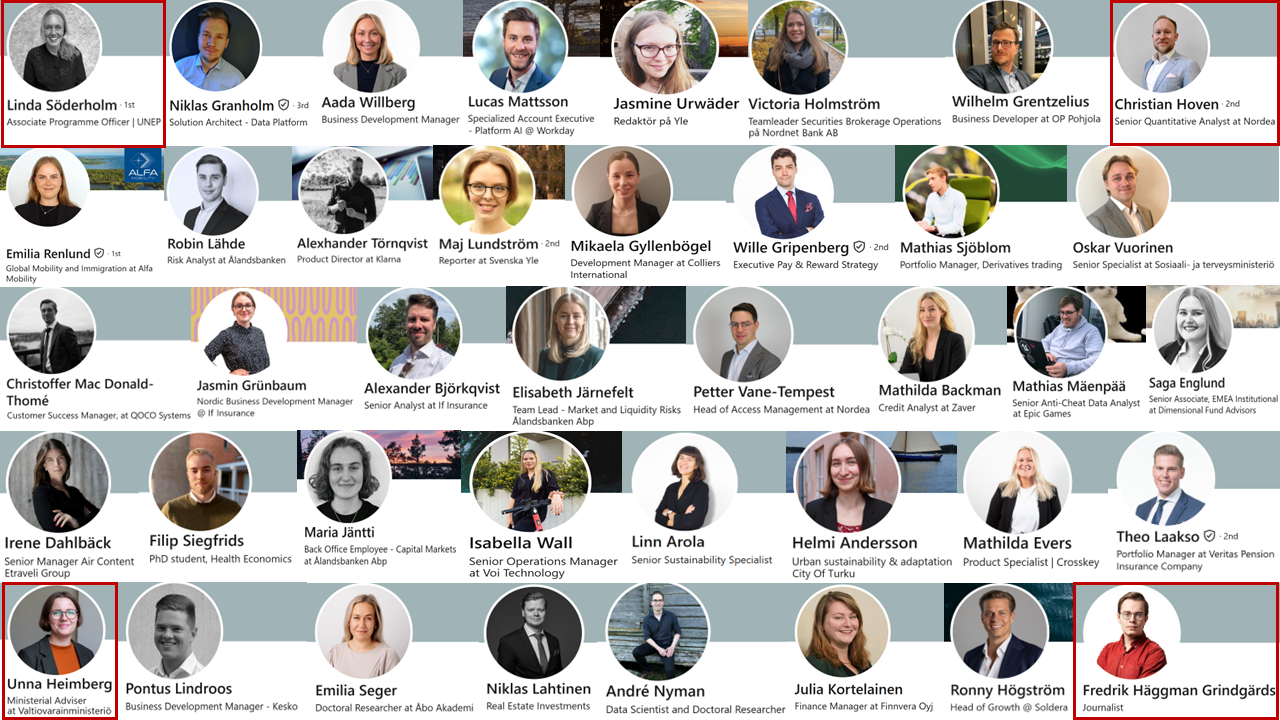
As you can see, economists can work on many different things and in very different workplaces. Top left is Linda Söderholm. Linda is an expert in environmental and development issues. She has previously worked in Zambia, Chile and South Africa and now works for the UN in Kenya. Among other things, she advises policymakers on how to fight the poverty that is still widespread in these countries. Top right is Christian Hoven, who works as a quantitative analyst at Nordea. His job is to analyse large amounts of financial data. Based on Christian’s analyses, Nordea can advise companies and private customers on how to invest their money. Bottom left is Unna Heimberg, who works at the Ministry of Finance in Helsinki. There she helps the government with economic policy. Together with her colleagues she ensures that ministers have the best possible basis for decision‑making. Bottom right is Fredrik Häggman. He is currently head of news at Hufvudstadsbladet, where he writes daily about developments in the economy.
So what do Linda, Christian, Unna and Fredrik have in common? I would say — like everyone else in the picture — they are good at analysing complex problems. They have all learned to handle large amounts of information and to pick out what matters. They are skilled at presenting their conclusions in speech and in writing. And perhaps most importantly: they are quick learners. Working life is changing at a furious pace right now, and you need to be able to take in new knowledge and new techniques all the time. You will practise all these abilities during your years at university. Just remember: to succeed in your studies you must keep up throughout the whole programme and practise every component — just like the 10‑year‑old who learnt to do the backflip.
How to use this book?
This e‑book is an introduction to economics at university level and covers the basics of both microeconomics and macroeconomics. I have written it based on three of my pet principles:
Test yourself! An effective way to study is to work with exercises and past exams. That’s why each chapter ends with plenty of self‑grading tests. There you get black‑and‑white feedback on how much you actually understand. Then go back and review the things you had trouble with in the test.
Data, data, data! Our era is characterised by an abundance of data, and economists are experts at analysing this information. In this book I have therefore included charts and interactive maps so that you can explore how things look around the world. There are also data simulations you can play with to better understand how the theories work.
As short as possible! Economists emphasise that time is limited, yet many write brick‑thick textbooks—as if students have all the time in the world to read. Many books are also written for US universities, where a course can last an entire academic year. I have therefore tried to keep this book as concise as possible. For those of you who want to learn more, I have included links to other textbooks.
On YouTube I uploaded some videos many years ago about basic microeconomics here and macroeconomics here. The clips are sometimes outdated, were made in a hurry and rarely match the structure of this e‑book, but if you want to prepare before a lecture and/or review after a lecture they might help. Remember, however, that it is the material in the e‑book that will be examined.
-
If you are studying economics at Åbo Akademi you can get personal support from the special educator Malin. In this short clip she explains more: