More economics?
The goal of the bachelor’s programme in economics is to make you a skilled analyst who can confidently tackle complex economic challenges in both business and wider society. With these skills you open up excellent opportunities for many stimulating jobs (see, for example, here).
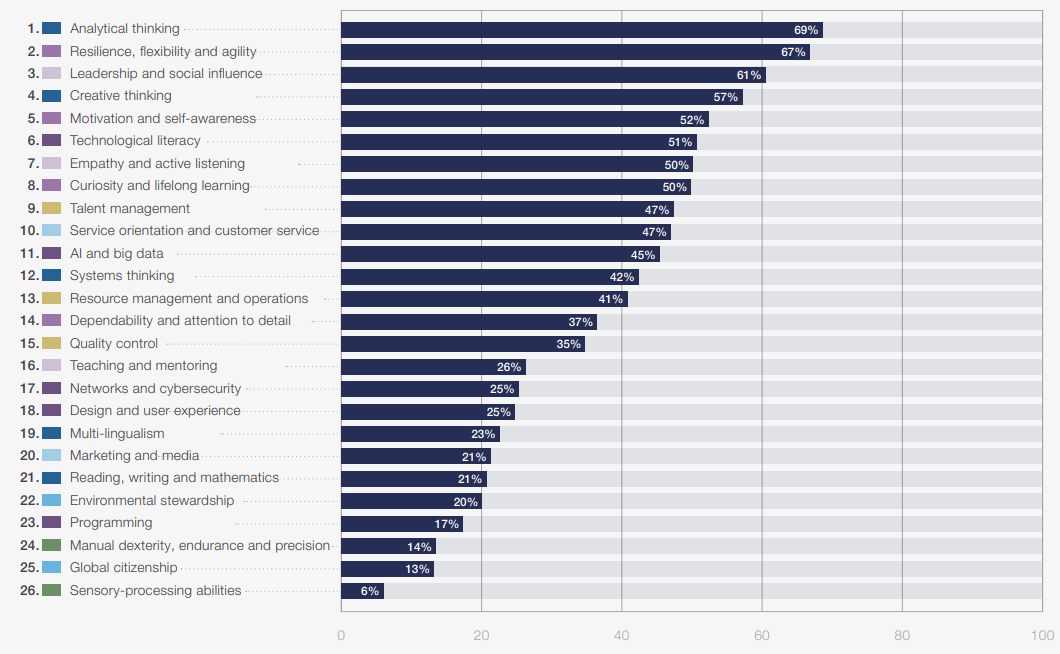
Below you see the list of skills employers value most in their staff. The figures show the share of employers who say each skill is a “core skill” their employees must have.
 .
.
As you can see, analytical thinking tops the list. Second is resilience — the ability to handle difficulties and challenges without giving up. Employers also value fair treatment of others, creativity and a willingness to keep learning. You will practise all of these during your studies.
Our courses meet international standards in both content and level; we obviously want to ensure you become competent enough to do well in the labour market. After completing your bachelor’s degree you are eligible to apply for master’s programmes in both economics (EM) and social sciences (PM). Here is a 10‑minute video where ÅA economics students talk about what it’s like to study economics.
Personally I would say two things are especially important if you’re thinking of studying more economics:
Are you ready to commit to your studies? I believe it’s important to approach your studies with determination. Going to university means you sacrifice several years of your life (and a scary amount of foregone earnings) to invest in your future. Don’t waste that opportunity — make the most of this time. Plainly: attend lectures, read the course literature and study actively. You’ll quickly discover that economics is surprisingly straightforward and fun — and motivation usually follows naturally. We’re happy to help you — but you must want it yourself. Motivation always beats raw ability.
See the big picture! Remember Figure 1? In a few years you will enter the labour market. Work will be more enjoyable if you have a solid foundation. The equity analyst who doesn’t know how to diversify away firm‑specific risk when building stock portfolios won’t last long in the industry. The development economist working for the World Bank in Burundi must be able to evaluate how a large aid project affected famine in the country. And who wants to work as a corporate analyst without a clue about how to analyse market data or assess pricing strategies? Treat each course as a new chance to add tools to your toolbox. Just as each course is progressive — week 2 builds on what you learned in week 1 — the entire degree is progressive. That means you keep getting better, and after three years you will be a competent economist.
Below you can see which economics courses are included in the three‑year bachelor programme starting in autumn 2026. If you click a course name you go directly to that course’s webpage. You can always check whether a course suits you and you can always revisit past courses for revision.
Year 1: In your first year you take courses across many disciplines. Try to see how each subject contributes in its own way to explaining the world. In your first year it is also important to develop a study technique that works for you — you will benefit from it throughout your studies. If you follow my tips in Surviving university I’m confident you will do well.
Introductory course in microeconomics. In this introductory course you get your first picture of what economics is about and learn that we work with theory and data. You learn how economic forces shape life at the Market Square in Turku. So keep your eyes open next time you walk past the square! Extremely expensive strawberries, shop closures on the high street, a friend earning €9,000, a drunken brawl on Friday night, a soda advertising campaign or a demonstration against immigration — all of this and much more can be better understood with economics.
Introductory course in macroeconomics. Here we leave the little world around the market and imagine ourselves on the ISS looking down at countries. We aim to understand the really big macroeconomic questions. Why do so many children starve in Burundi while we live in abundance in Finland? Why are economies sometimes plunged into deep recessions with bankruptcies and sky‑high unemployment — and why do economic bubbles arise where everyone suddenly gets rich? Why did prices in shops surge in spring 2022 and why are there always hundreds of thousands of Finns who want work but cannot find it? How does Finland get affected by events abroad? Can politicians steer the macroeconomy in a desired direction — and how would they do that?
Ekonomisk matematik. In this course you learn basic mathematical techniques needed for your studies and in the workplace. For example, you learn how to calculate VAT and interest and practise handling indexes, currencies, functions, derivatives and other methods. These skills are indispensable tools for anyone who wants to analyse economic problems. Differentiation, for example, allows you to understand how small changes in costs or demand affect a firm’s profits.
Year 2: In the autumn of your second year you will get acquainted with different fields of economics. You might find an area you’re particularly passionate about.
[Internationell trade]. Every time you open a newspaper or go online you encounter headlines about globalisation: “Åbo shipyard wins luxury cruise order!”, “Cheap clothes on Temu force a Finnish retailer into bankruptcy!”, “Trump threatens Finland with higher tariffs!”, “EU boycotts trade with Russia!”, “War in the Middle East triggers a new refugee wave to Europe!”, “World trade increases global warming!” In this course you become an expert on the modern global economy. Why does Finland export some goods and import others? How are Finnish firms and consumers affected by increasing international integration? Does globalisation destroy low‑skill jobs while raising wages for the highly skilled? Can — and should — economic policy be used to tame globalisation?
Microeconomic analysis. In this course you learn the core principles of microeconomic theory, centred on analysing how consumers and producers optimise decisions under constraints. You study utility maximisation, demand analysis and welfare analysis.
Strategic behaviour. This course teaches you basic game‑theoretic tools to predict actions in situations where agents’ choices affect and are affected by others. You learn to analyse auctions, arms races, strategic interaction among firms (oligopoly), cartels, voting behaviour, free‑rider problems and wage bargaining.
Macroeconomic analysis. Here you study business‑cycle analysis in more depth. You learn advanced theories about why economies can overheat or fall into deep recessions in the short run — and how policy can handle these swings. You also learn to analyse the macro outlook using data. The course includes study visits to banks and insurance companies where economists work on practical macro analysis.
Quantitative methods. Our era is characterised by an explosion of data. In a world drowning in data there is huge demand for people who can analyse it. In this overview course you learn the basic statistical techniques every respectable economist and social scientist must master. How do you, for example, analyse a firm’s sales data and produce professional charts that describe trends and relationships? How do you download an Excel sheet showing crimes per municipality last year and test whether crime was higher where child poverty was high and police numbers low? Throughout the course you work with real data. You can choose to work in Excel or SPSS.
Year 3: In the third year the focus shifts more to data and empirical methods. In the econometrics courses you learn advanced techniques to measure how the world actually looks. You apply these techniques to explore puzzles and labour‑market trends. You also learn how to write, present and discuss scientific reports. In the spring term you write your bachelor’s thesis, which completes the degree.
Labour economics. No market affects you as much as the labour market. We therefore take a deep dive into working life. Why do metalworkers earn 50% more than nurses and why do top executives earn ten times their employees? Why have income gaps grown in our lifetime? Why is unemployment high in some places and low in others? Are robots taking jobs? You learn to analyse patterns and trends in working life using economic models and data techniques.
Econometrics. You learned the basics in Quantitative methods, but to work as an analyst you must master statistics at a deeper level. Only then can you identify pitfalls, choose the best method, find new solutions and explain conclusions to clients clearly. In this course you continue analysing concrete questions using cross‑section data. What assumptions underlie your conclusions? You also learn to code in R and add techniques to your toolbox that are invaluable for exploring and understanding the world.
Applied econometrics. Here you learn advanced causal‑inference methods. For example, there is a clear association between mental ill‑health and social‑media use: heavy users show more symptoms of depression and anxiety. But are social media causing ill health (so ill health would disappear if we shut down social media)? The association might be causal — or it might reflect confounding factors (maybe heavy social‑media users are more often unemployed, and unemployment is devastating for health) or reverse causation (poor mental health leads to more screen time). In this course you learn methods to estimate causality such as regression, panel data and fixed effects, difference‑in‑differences, instrumental variables and regression discontinuity.
[Mästarprovet]. In this course you learn how to write and present a scientific report. What makes a clear and interesting research question? How do you use economic theory to analyse your chosen question? How do you choose the empirical method that best suits the question — and how do you structure your text to make it readable? You write a short, independent report on a topic of your choice and practise giving and receiving constructive feedback and presenting your conclusions orally.
Bachelor’s thesis in economics. Your bachelor’s degree concludes with a term‑long project where you specialise in an area you like. Your task is to answer an economic question independently and credibly using the toolkit of theory and empirical methods you have built up. About 50 students write the bachelor thesis in economics each spring, so we work together and help each other. A list of past theses is available here.