The Economy, Stupid!
Understanding Life Through Economics
Welcome!
We live in an exciting world. Take a look at the webcams below. The left one shows what’s happening right now at the Market Square in Turku (Åbo), while the right one is a live feed from the International Space Station (ISS):
En svensk version av den här e-boken hittar du här.
Economics is about understanding these worlds. The first half of this book covers microeconomics, that is life on the small scale. With microeconomics you can make sense of everyday life around the Market Square in Turku. If you look closely, you’ll see that life on the small scale is full of fascinating puzzles:
Why are so many cosmetics and Thai massage services sold, while travel agencies are becoming fewer and some occupations disappear entirely? Why is it relatively easy to find housing in Turku but almost impossible in Stockholm? What makes a pair of iPhone earphones cost €180? Why does a stockbroker earn €8,000 a month while others working around the market can barely afford food? And why do people keep flying to Thailand, even though everyone knows it contributes to global warming?
All this — and much more — you can understand with microeconomics.
In the second part of the book we leave the Market Square in Turku and move on to macroeconomics. There we study life on the large scale. You can imagine yourself on the ISS looking down at Earth. Which country is the station over right now — and why is living standards there likely much lower than in Finland? Why do countries often end up in economic crises, as if a wet blanket suddenly gets thrown over all markets at once? Are some countries destined to be poor, or can you, as an economist, do something to help more people have better lives?
To me, economics is a fascinating and important subject. When Bill Clinton was running for US president his advisers coined the phrase The Economy, stupid!
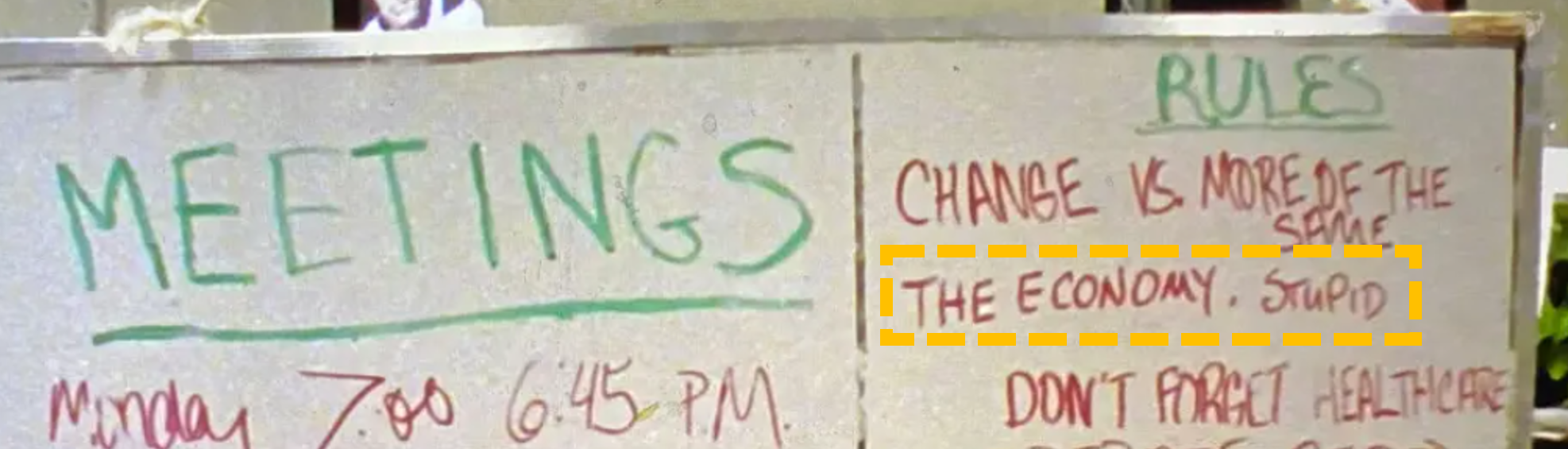
The slogan was meant as a constant reminder to campaign workers to emphasise economic issues. Incumbent president George H. W. Bush had long enjoyed strong support among Americans, but the country’s economy deteriorated during the election year — and Clinton intuitively understood that money often ultimately decides how people vote.
You will soon discover that the wallet, for better or worse, has a huge effect on how people behave — even in the most unexpected situations.
Turku, 25 August 2026
Jonas Lagerström