1 What economists do
(where you learn how we use theory and data to understand the world)
It is worrying times in Lestijärvi in Central Ostrobothnia. Here — as in many other places in Finland — demography is a matter of destiny. Finns are living increasingly longer, which means people over 65 make up a growing share of the population. At the same time fertility has fallen dramatically, from 1.86 children per woman to 1.28 children per woman in just the last decade. In addition, Lestijärvi and many other sparsely populated municipalities are desperately fighting depopulation. Many worry that soon there will be no young people left in Lestijärvi to support all the elderly.
So what should Lestijärvi do to raise the birth rate and stop the flight to the cities? The politicians took a radical decision: from 2013 the municipality would pay a bonus of €10,000 for each newborn child.
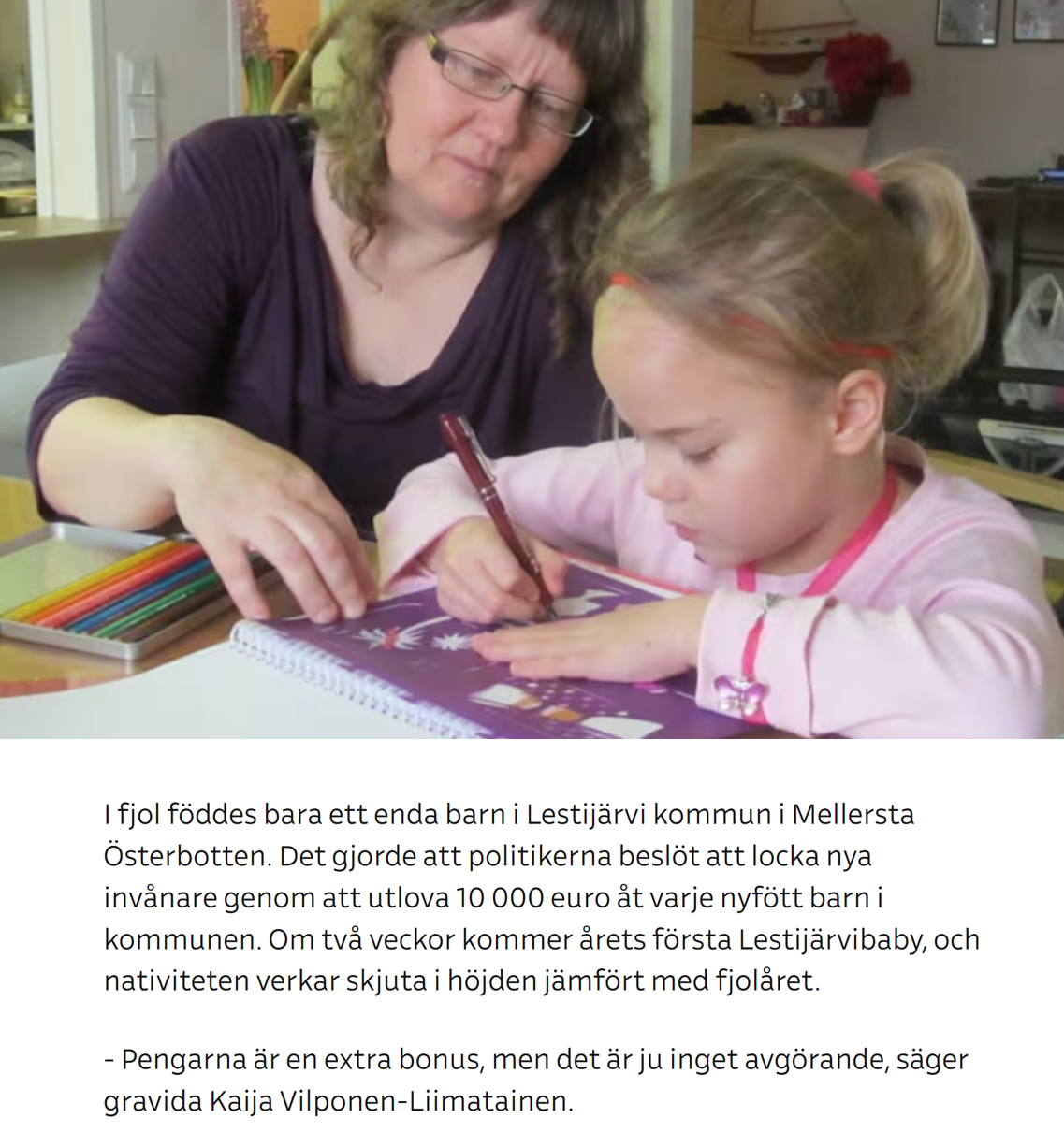
What do you think of this experiment? Does it reflect a cynical view of human nature, or do you think the bonus actually led to increased activity in the bedroom? Let’s see how an economist would approach the Lestijärvi case. It’s about two pieces that are equally important and that together form an extremely potent combination: theory and data.
1.1 Theories explain why
In 1687 Isaac Newton presented a groundbreaking theory about how the universe works. But how did he manage to explain something so immeasurably large and complex? In our galaxy alone, the Milky Way, there are roughly 400 billion stars, and the universe contains about 2,000 billion such galaxies. Every tiny grain of sand consists of roughly 100 trillion atoms, and every atom is made up of even smaller particles. Newton argued, however, that much of the universe can be explained by gravity — the attractive force between two bodies: the heavier they are, and the shorter the distance between them, the stronger the pull. With the help of this simple but powerful theory, humans could suddenly understand many phenomena, such as the motion of the moon and why apples fall to the ground.
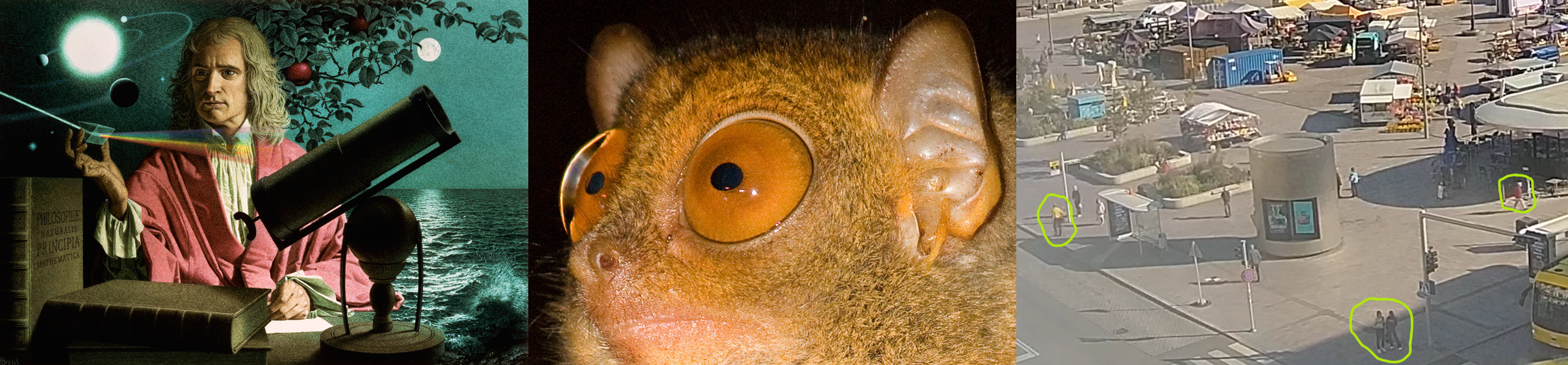
A theory at least as dazzling was proposed by Charles Darwin in the mid‑1800s. Darwin argued that there is variation within populations of organisms and that individuals with traits that make them better adapted to their environment are more likely to pass their genes on to the next generation. It quickly became apparent that this theory of evolution — “natural selection” — could explain many puzzles in biology. Suddenly we understood why the giraffe on the savannah has such a long neck and why nocturnal primates have such large eyes.
We economists also use theories to understand our world. For us it’s not about the pull between planets or the emergence of species, but about something even more challenging: we want to understand human behaviour and how it shapes our world. In the picture above I have circled some of the people on the Market Square. Just as Newton sought to predict the motions of the planets, we will now try to infer how these people choose to live their lives.
Where is the person headed?
Life is complicated. Every day you face a multitude of situations where you must make a decision:
- Should you get out of bed?
- Should you buy a cappuccino at the Market Square?
- Should you take more courses in economics?
- Should you have children?
- Should you commit a murder?
Studies have shown that a person makes between 2,500 and 10,000 such choices every single day. But how can we ever hope to understand how people make all these decisions? After all, there is a huge difference between deciding to get out of bed and deciding to kill someone. Also, there are eight billion people and every person is unique.
When economists analyse human behaviour, we usually start from a simple principle: we assume that most people are rational and choose what makes their lives as good as possible. This assumption of rationality is central to economics. If the assumption holds, we should be able to predict people’s choices by seeing which option pays off best. Let’s look at an example:
Elon Musk is on his way to work. Elon is currently the richest person in the world with a fortune of $1,100 billion and an hourly wage of $300,000. Suddenly he drops a wad of cash in the street — and faces a choice: should he bend down to pick it up, or ignore the money and walk on to work? What do you think Elon does — and why?
Here’s how an economist would analyse the problem:
“Elon will probably choose whatever is best for him. There are pros and cons to picking up the notes. The benefit is that he gets more money. The cost is that Elon must sacrifice 10 seconds of his life to turn around on the street and bend down. Time is money — and in Elon’s case that’s no exaggeration. His hourly wage of $300,000 corresponds to about $84 per second. Ten seconds therefore equals $840. My guess is that Elon will only pick up the bundle if it contains $840 or more.”
I like to liken decision‑making to standing at a crossroads in the forest. Which path you choose depends on which path makes your life better. The poet Robert Frost reflects on his life choices in the poem The Road Not Taken:
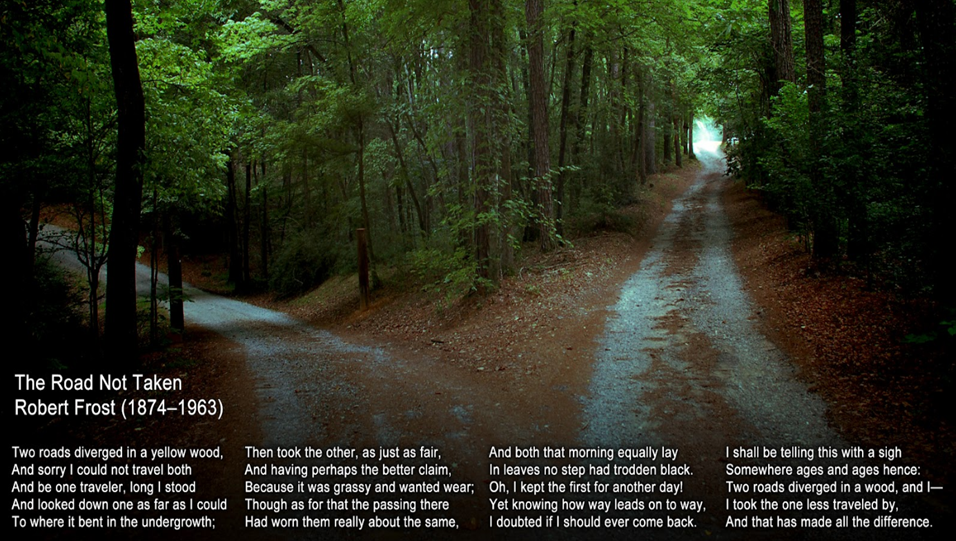
If you think about the choice of path, you realise that every choice you make always involves giving up something else. You must always sacrifice — nothing is truly free. If you choose the right‑hand path you miss out on the left‑hand one, and vice versa. What Robert Frost calls The road not taken economists call opportunity cost.
Studying also has an opportunity cost. What would you have done if you had not studied? Maybe you would have backpacked around Asia? Or earned €3,100 a month in a fun job? Or volunteered at an orphanage high in the Andes and helped hundreds of vulnerable children to a better life? Unfortunately none of these alternatives happened — because you chose to spend your time studying instead. The truth is that everything costs. Economics is sometimes called “the dismal science” because we constantly emphasise that nothing is free.
the assumption of rationality means we assume the individual chooses the best possible option given what they know
opportunity cost is what you give up when you choose something else; your opportunity cost of studying at Åbo Akademi is therefore what you would have done if you were not studying there
And even if you had unlimited time, you hardly have unlimited money. Think of Linda in Figure 1 who works in Zambia fighting hunger. With limited development aid she must choose between vaccinating 50,000 infants against malaria or building 10 rural schools. The funds are not enough for both — she must choose. If she vaccinates the children there will be no new schools, and if she builds the schools the children go unvaccinated. Unna at the Ministry of Finance faces the same dilemma: should she spend €50 million on raising student grants or should the money instead go to help the homeless? If the money goes to students, the homeless lose out — and vice versa.
You can reason like this about every choice in life. Imagine Ronja, who has just finished upper secondary school and is working a summer job at Prisma. She has been accepted to Harvard University. Now she is weighing her future: should she accept or decline the place? The benefit of the degree is that it almost guarantees Ronja a fun job with a high salary. The downside is that tuition fees for three years at Harvard add up to €120,000. But there are further costs. If Ronja did not study — The road not taken — she would have done something else during those three years, for example stayed at Prisma and earned €72,000. So what do we predict Ronja will do? She will start the degree if she judges that the benefits of studying are at least €192,000. Hopefully you can already see how different changes, according to theory, will affect Ronja’s decision to study. Higher tuition fees should reduce the chance Ronja accepts Harvard, and wage cuts at Prisma should increase the chance.
Or think of Kaija Vilponen‑Liimatainen and the others in Lestijärvi who face the choice of whether to have children. Children are lovely, fantastic, wonderful — but honestly there are costs too. You need to buy nappies, make formula, pay daycare fees. There are also things you must give up if you have children; it becomes practically impossible to party five nights a week, trek in the Himalayas or do whatever you would have done had you chosen the child‑free path. So how does Lestijärvi’s baby bonus fit into our theory? Well, adding €10,000 along the path that leads to having a child should make that option a bit more attractive. The effect may be small or even negligible, but it’s hard to imagine the cash bonus would lead to fewer children, right? Our simple theory of childbearing thus predicts that the bonus, ceteris paribus, should be able to increase births in Lestijärvi.
The critique of economic theory
When I studied economics there were several things that annoyed me and my fellow students. One of them was that we never really understood the point of theories. This is what we said during the breaks between lectures:
»Talk about out of touch with reality — this is like solving sudoku! By the way, I know several people who don’t behave like that at all, so the theory must be wrong! There’s no way people have children for the money!«
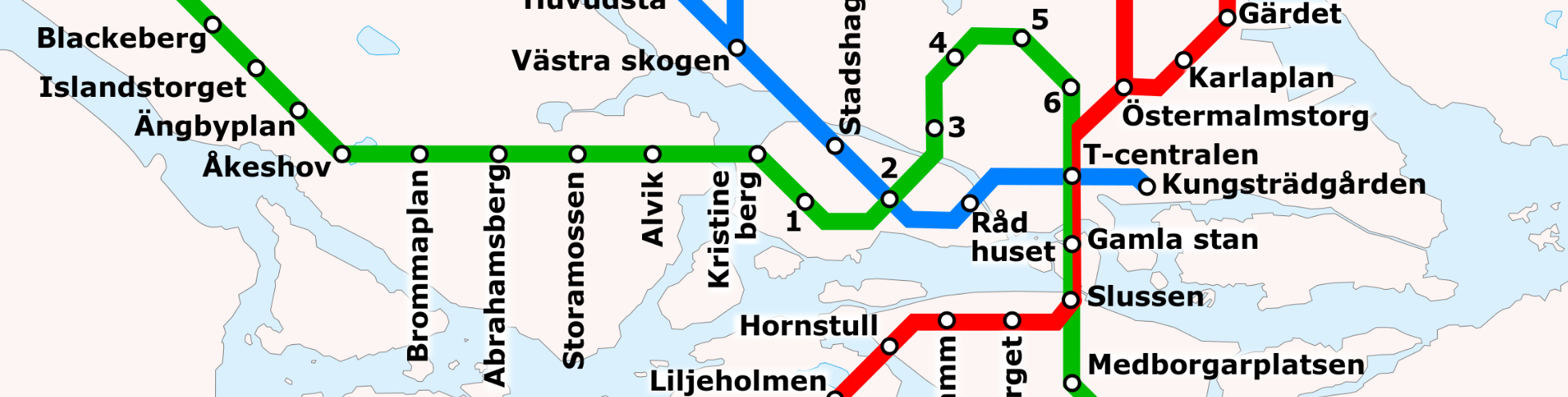
It took me many years to understand how theories actually work. I wish someone had explained this to me back in the introductory course. So what is a theory, really? I like to think of theories as “simplified models of reality”. A subway map shows lines and stations, but it doesn’t show the exact distance between stations or where the shops and pharmacies are. You have simplified and removed things that aren’t strictly necessary — and you’ve done this so the model becomes easy for you to use.
Or think of the Wright brothers, who carried out the first controlled flight in 1903. How did they achieve their triumph? The key to their success was a wind tunnel.
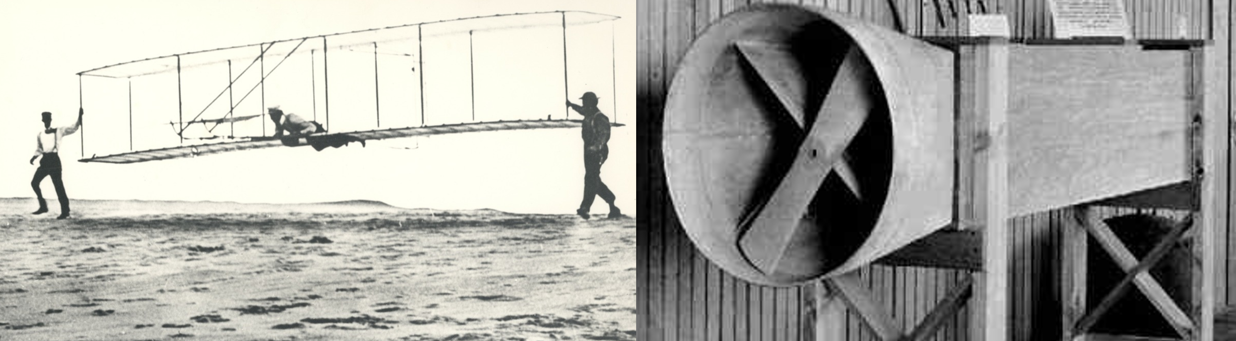
Instead of building large aeroplanes straight away — which often crashed — the Wright brothers chose to experiment with models in a wind tunnel. There they could calmly model the optimal aeroplane. What happens if we change the angle of the wings? Is the plane more stable if we make the elevator larger? How is the flight affected if the wing is flatter? This strategy minimised both costs and time, since they didn’t have to build a new full‑size plane every time something went wrong.
The conditions in the wind tunnel of course did not exactly match real flying. There was no fog, no clouds, no seagulls and no mountains — yet it still gave a sufficiently realistic picture of how an aeroplane would behave in the air. When the brothers finally developed a model that flew well in the tunnel they built a full‑size plane — and entered the history books.
No sensible person believes that a subway map or a wind tunnel gives a 100% true picture of reality — or that every individual always acts perfectly rationally in every situation. Yet we can often benefit from many models to better understand how the world works. But how do we know which models are good and which are bad? We’ll explore that now.
1.2 Data show what actually happened
Newton and Darwin emphasised that theories must be tested against real data. If the planets did not move as the law of gravitation predicted, Newton argued his theory should be discarded. Similarly, biologists’ confidence in Darwin’s theory was strengthened, for instance, by observations that male fish in areas with many predators are less colourful — presumably because bright colours attract mates but also make them more visible to predators.
In the same way, economic theories must always be tested against data from the real world. We predicted that the €10,000 bonus would lead to more births — but did it? And if so, how large was the effect? Did the bonus lead to 1, 10 or 100 extra births in Lestijärvi?
There are many ways to measure how the world looks. From Statistics Finland’s website I downloaded an Excel file that shows exactly how many children were born in each municipality in Finland. Below I had the computer draw a figure showing births in Lestijärvi during 2004–2019. The green line marks when the reform was introduced. How do you interpret the figure?
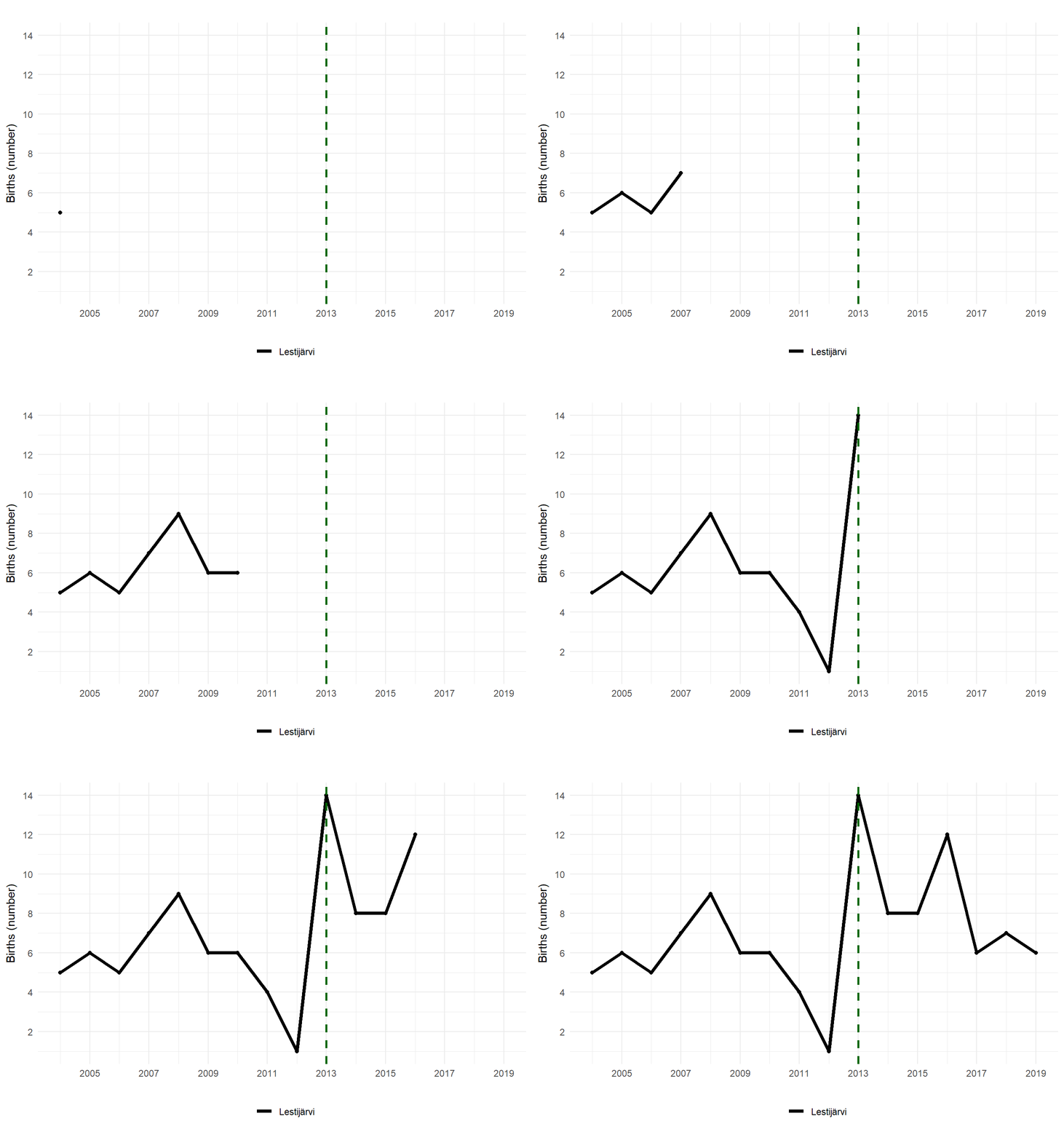
It certainly looks like the bonus led to more births, doesn’t it? Births do vary a lot year to year—especially in small communities—but before the reform Lestijärvi had on average about 5 births per year, and after the reform almost 10. A first guess is therefore that the bonus really boosted births in Lestijärvi. The number of newborns appears to have doubled thanks to the bonus. That would be great news for any politician worried about demographics: introduce a generous bonus and depopulation will soon be a thing of the past!
But hold your horses. Remember The road not taken! We know what happened to births in Lestijärvi after the bonus was introduced — but we don’t know what would have happened if the bonus hadn’t been introduced. Maybe births would have increased anyway. Perhaps something happened in Finland in 2013 that raised birth rates in all municipalities: better economic times, greater optimism, more money in people’s pockets, more childcare places, changes in family policy, or even the launch of the dating app Tinder at the end of 2012. The baby boom in Lestijärvi could, in truth, have many explanations. How can we ever know whether the increase was actually caused by the bonus?
A smart way to address this problem is to look at what happened to births in other sparsely populated Finnish municipalities that didn’t introduce a bonus. What happened, for example, in the municipality of Brändö? If we observe the same increase in Brändö as in Lestijärvi, that would suggest the boom in Lestijärvi was not due to the bonus but to some other factor affecting births more generally (for example, the launch of Tinder). The following figure shows the answer:
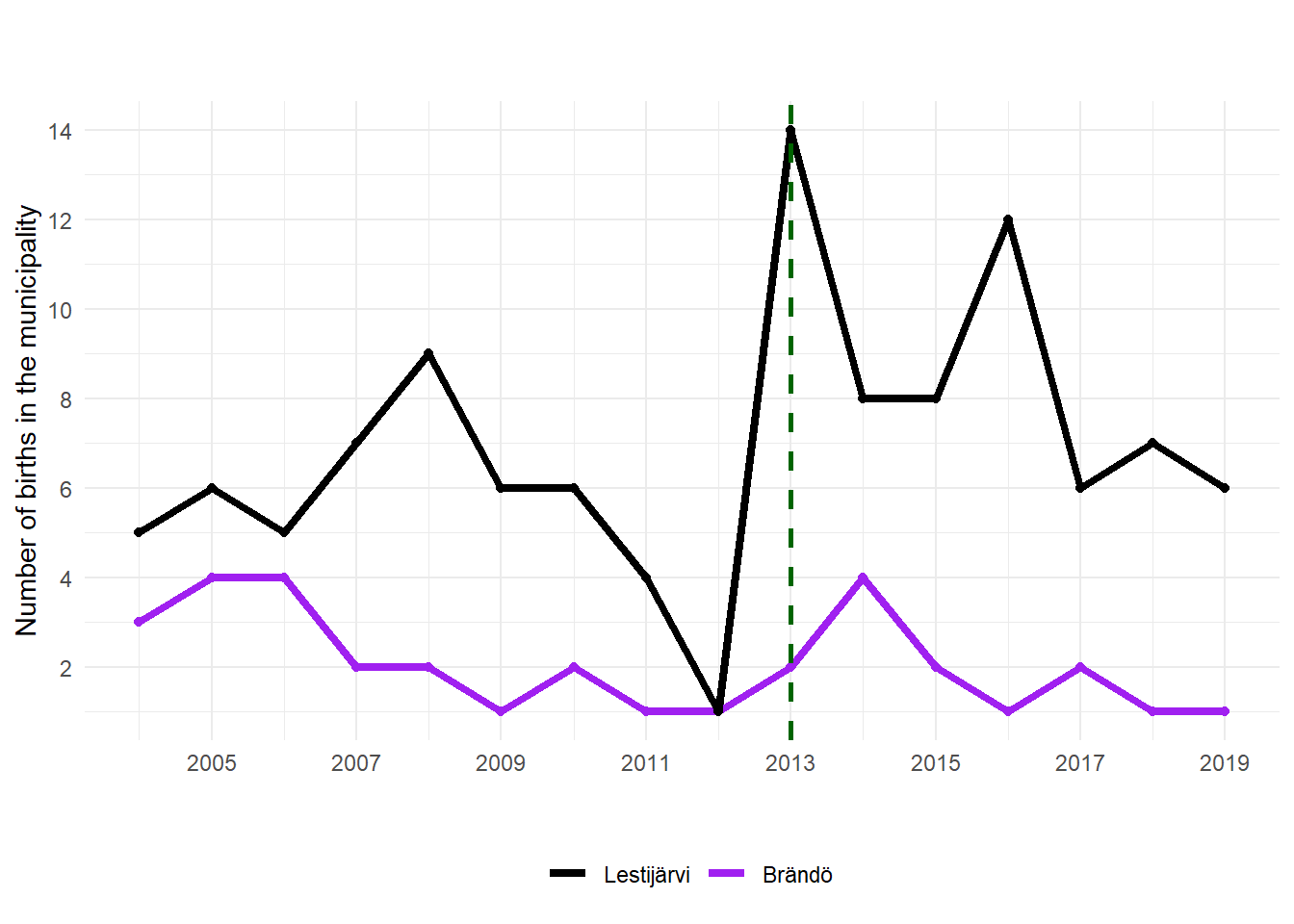
As you can see, births in Brändö did not change noticeably over the period. That strengthens our conclusion: the doubling of births in Lestijärvi does indeed appear to have been caused by the bonus.
A hallmark of our time is that the world is overflowing with information and data. For those who master the tools, it has never been easier to explore the world. And once you start digging into a topic you will find new puzzles. For example, the bonus is paid as €1,000 per year for 10 years, but payments stop if you move away from Lestijärvi. In theory the reform should therefore reduce the number of families with children leaving Lestijärvi. Those most likely to stay would be families with many young children who still have many €1,000 payments left to collect.
It is relatively straightforward to download migration data for Finnish municipalities and measure whether the baby bonus actually led to fewer families with children leaving Lestijärvi. And while you’re at it, why not also investigate whether the reform attracted more young people to Lestijärvi? The most likely movers might be pregnant women expecting triplets who live just outside the municipal border. The possibilities for interesting analyses are almost endless.
At Statistics Finland here you can see how many people moved to and from Lestijärvi during the period.
1.3 Economic imperialism
This way of thinking — that most of us are rational and choose the path we think is best — can be applied to all sorts of situations. Economists have therefore used their techniques to analyse phenomena that lie outside “traditional” economic questions.

As a crime economist you can, for example, study how income inequality, the probability of being caught and punishment severity affect burglary rates. In political economy you can measure whether more polling stations and longer opening hours increase voter turnout, and an education economist can investigate whether teachers at independent schools really give inflated grades to attract more pupils. This kind of “imperialism” has faced strong criticism from representatives of other disciplines, who argue that the economist’s way of thinking is too narrow to fully capture the complexity of their fields.
The figure below shows what topics economics students at Åbo Akademi wrote their bachelor theses on in spring 2023. Can you spot any examples of “economic imperialism”?
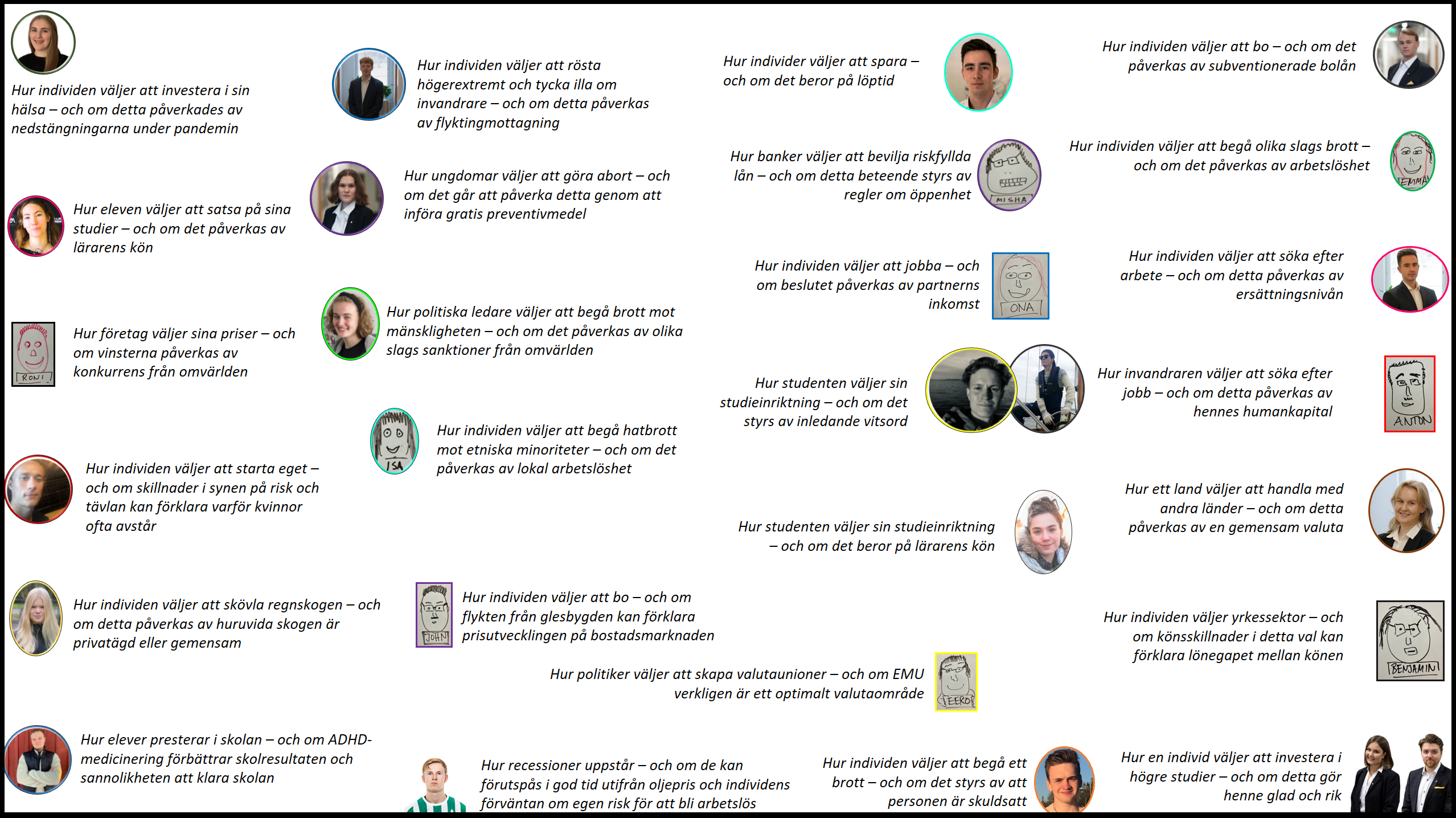
Some examples:
- Pontus analysed unemployment in 29 countries over 10 years and showed that a 10 percentage‑point increase in benefit replacement rates (for example, if the unemployed receive 70% of their previous wage instead of 60%) typically leads to an increase in average unemployment duration by roughly 16 days.
- Wilma studied deforestation of the rainforest. She used online data on forest cover for about a dozen of the world’s poorest countries — and found that deforestation often falls when the state takes over ownership of the forest. Piettu and Casper investigated whether women tend to avoid fields of study where it is hard to get high grades, a proposed explanation for occupational gender segregation. Using data from Åbo Akademi they found that students tend to choose majors where it is easier to obtain high grades (if a subject becomes “grade‑lenient”, the probability of students choosing it increases by 5–10 percentage points), but they found no evidence that women are more grade‑sensitive than men. Thus the gender segregation in education does not seem to be driven by men and women reacting differently to grading.
- Emma examined crime across all Finnish municipalities during the 2000s. Among other findings, she showed that rising unemployment increases violent crime: when unemployment in a municipality suddenly rises by one percentage point, violent crimes typically increase by about 1.27%.
- Henrik investigated why so few Finns start businesses. He analysed characteristics of thousands of people to compare entrepreneurs and employees. He found, among other things, that entrepreneurs are on average more risk‑tolerant and less formally educated than employees.
1.4 Behavioral economics: Are you really rational?
Lately, however, more and more economists have realised that the assumption of rationality must be taken with a hefty pinch of salt. In behavioural economics researchers borrow insights from psychology to get better at predicting human behaviour. It turns out that many of us find choosing hard. Sometimes we are emotional, impulsive, confused and apparently illogical.
Example 1: Increased fines at daycare. Daycare staff in Israel were furious that many parents picked up their children after closing time. They therefore introduced a three‑dollar fine for late parents.
“Now parents will arrive on time!” grumbled the staff.
But the effect was the opposite. The number of late parents doubled. It turned out that parents now felt justified to have a coffee after work because they had “paid” for the extra daycare time. With money they bought themselves free from moral guilt.
Similarly, attempts to encourage blood donation with financial incentives have sometimes reduced the number of donors. The monetary reward has turned a noble act into a tawdry, greedy way to extract body fluids for a few euros. The lesson here is that there are other motives besides economic ones, and increasing monetary incentives can crowd out other kinds of motivation.
Example 2: An elderly man lives in a house with a terrace facing the street. When children walked home from school they used to scrape wooden sticks along the fence, and the sound irritated the man. He stops the children and says:
“That’s a very nice sound you make with the sticks! From now on I’ll pay you one euro for the service.”
After a few days he stops the children a second time:
“I’m out of euros, so from now on I’ll only pay you 50 cents.”
A few days later he stops them a third time:
“I’m out of money, so unfortunately I can’t pay you.”
“No money, no sound!” said the children.
Example 3: You run a travel agency in Turku. Your bestsellers are two different trips for retirees: a weekend in Paris for €700 and a weekend in Rome for €700. Both packages include coach travel, meals at nice restaurants, exhibitions, a guide and evening entertainment. Now Sven‑Erik, 81, walks into your agency. He finds it extremely hard to choose between the two trips. To Sven‑Erik they both seem equally good. And most people seem to agree — you sell about as many trips to Paris as to Rome.
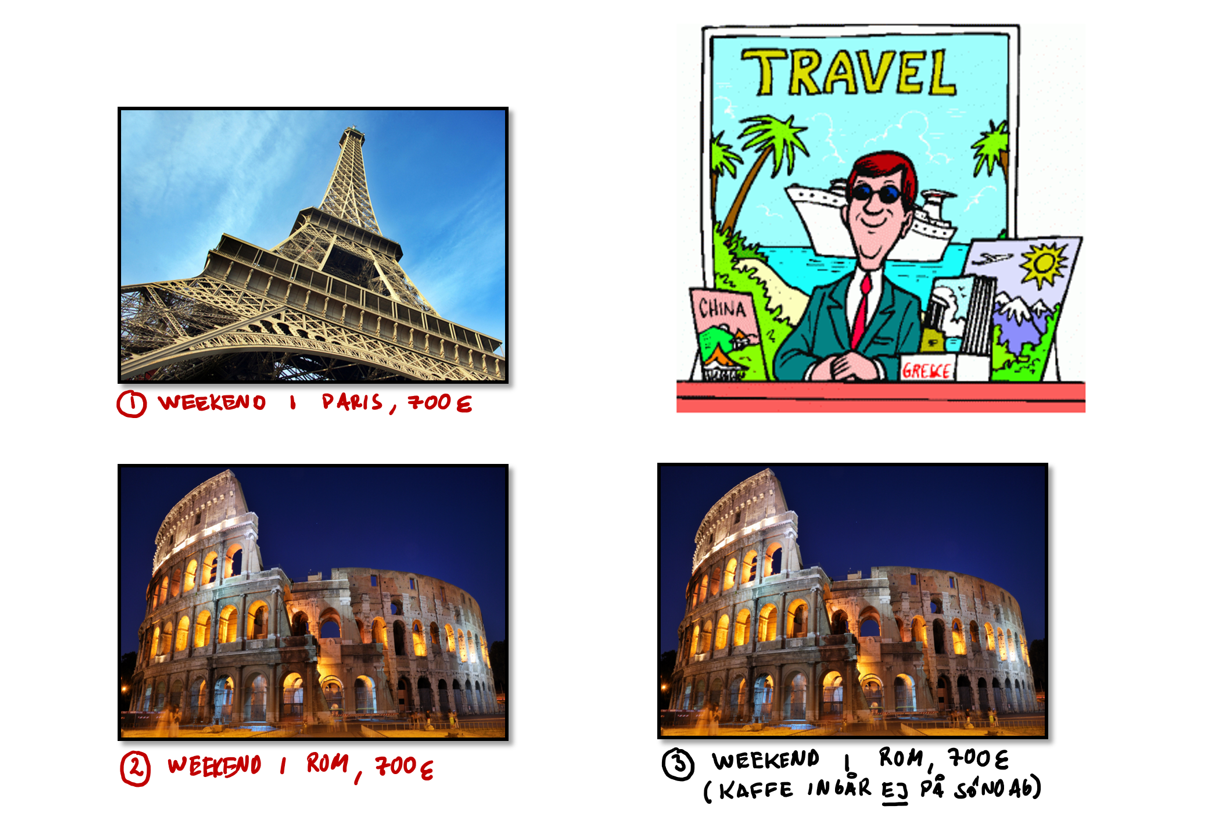
But now you suddenly introduce a third option. This is also a weekend in Rome and the price is again €700. It includes coach travel, meals, exhibitions, a guide and evening entertainment. In fact the trip is an exact copy of the other Rome package, but with one tiny difference: the new package does not include free coffee with lunch on Sunday. How do you think the new package will affect your sales?
As expected, virtually nobody chooses the Rome trip without the coffee. After all, why would Sven‑Erik pick package 3 when package 2 costs the same and even includes free coffee? More surprising is that more customers now choose a weekend in Rome instead of a weekend in Paris. Suddenly Sven‑Erik is certain: he definitely wants to go to Rome! Previously he thought Paris and Rome were equally attractive, but now he unhesitatingly prefers Rome. How can this be? One likely explanation is that people find it hard to rank different options. Sven‑Erik simply couldn’t decide between the original Paris and Rome packages. However, he intuitively sees that the Rome trip with free coffee is better than the Rome trip without coffee. In this way he is subconsciously steered towards Rome, which also increases the chance he picks Rome over Paris.
Sven‑Erik doesn’t seem to live up to our assumption of the coldly rational super‑human who can instantly rank options and choose whatever makes life best. But maybe Sven‑Erik is just a confused pensioner? Surely, for example, clever students at Åbo Akademi wouldn’t be influenced by such cheap sales tricks, would they?
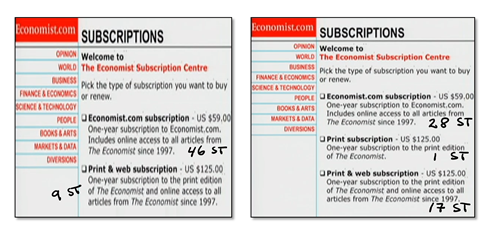
Example 4: A few years ago I asked students to choose between different real subscription packages for The Economist. Half the group saw the two options on the left below: buy the digital subscription for $59 or pay $125 and get the magazine in both print and digital. Only about 16% chose the more expensive package.
The other half of the students saw slightly different options. Here The Economist had added a third option: pay $125 and get the print subscription without the digital access. Suddenly 37% of students said they would choose the more expensive package. Can you explain why this happened?
Exercises
In this chapter you have learned that economics is often about how people make choices. We use economic theory to think about these choices and analyse data to see how the world actually works. Below are some exercises that test whether you have understood. Press Show Answers when you want the computer to grade your responses. Good luck!
Incentives, choices and opportunity costs
Economists often assume that people choose the path through life that makes their lives as good as possible. With economic policy it is — perhaps — possible to steer people by making certain paths more attractive.

- Economics is sometimes called because we emphasise that nothing is free.
- “How unemployment in Finland was affected by the pandemic” is a question, “How the probability that an individual works depends on the income tax” is a .
- Type the name of the concept that describes the value of the best alternative that must be given up when you decide to do something: .
- Assume people are rational. How should the following changes, according to economic theory, affect behaviour? If we raise fines or hire more parking wardens, it becomes less attractive to park illegally, which the number of illegal parkings outside the ASA building. If we make voting cheaper — for example by having more polling stations and longer opening hours — turnout will . If we increase student grants — or lower the price of the student lunch — then Finns will continue studying, and if we give universities money for fast graduation, then students will finish quickly. If we introduce fees that make flying and littering more expensive, emissions will and a tax on plastic bags will make customers choose paper bags instead. If older workers get tax cuts, then older people will want to work, and if it pays more to have children — for example via lower daycare fees or higher child allowances — then will have children.
- When the economics programme at Åbo Akademi introduced a €500 bonus to all students who completed their bachelor’s degree within six terms, throughput clearly increased — but it’s not certain this was caused by the bonus. Explain why!
- Inspired by the Lestijärvi birth analysis, how could you measure the effect of the student bonus in a way that provides even greater credibility?
- Give an example of a decision you made in the past 24 hours that was influenced by your wallet — and do you think politicians could have changed your decision by making the thing cheaper or more expensive?
- Each year the School of Economics in Turku awards about €400,000 in scholarships to good students. For example, a study pace of 60 ECTS/year gives about €750 per year. Good theses are also rewarded; in June 2024 we awarded €16,508 (tax‑free) to a student who met the criteria “male student who has shown zeal and aptitude for personal development, continuing education and activities to benefit the development of the Finnish wood processing industry.” Do you think it is possible to steer students with monetary incentives?
- Do you see any drawbacks to introducing such financial incentives in education?
- Your summer job at Prisma is in chaos: you have a mountain of cheese puffs in stock but the crisps are running out. Using lessons from the Rome vs Paris example, how would you get more customers to choose cheese puffs instead of crisps?
- How do you know what would have happened to throughput in the economics programme if we hadn’t introduced the bonus? Maybe other changes in society at the same time caused throughput to rise everywhere — for example better student preparation or reforms to study grants that made graduating quickly more attractive.
- Check what happened to throughput in programmes at Åbo Akademi that didn’t introduce a bonus.
- I bought a plastic bag at the supermarket. If plastic bags had been more expensive (for example because of an environmental tax), I probably would have taken a paper bag instead.
- I’d be interested to hear your views on this.
- The children stopped playing with sticks on the fence once it became a “job”. Might financial incentives similarly reduce intrinsic motivation for learning?
- Introduce a third option: sell a packet of cheese puffs that is a marginally worse version of the original. For example, offer a packet at exactly the same price as the original but containing 50 g less.
- If you want to hear two AI voices discuss the content of this chapter you can listen here. If you want to play with AI tools yourself, see the Data section at the top of the chapter here.
- Need other introductory microeconomics textbooks? A good introduction in English is Team (2024) (free e-book here). A Swedish alternative is Bergh & Jakobsson (2022) (available at Åbo Akademi Library here) or the excellent classic Eklund (2020).
- The full article on Lestijärvi can be read here. One in five municipalities in Finland pays baby bonuses to families and in a few municipalities the amount reaches €10,000 (source here). If you want to see births per woman over time worldwide, interesting charts are available here.
- I wrote a column about economic incentives here.
- Another highly recommended read on economics is the bestseller Freakonomics by Dubner & Levitt (2014), which shows how economic techniques can be applied to new and surprising questions. Does having a foreign‑sounding name make it harder to get a job? How common are match‑fixes in sumo wrestling? Why did crime fall in the US? Freakonomics is available as an e‑book here).