18 Monetary policy
(where you learn what economists do to keep prices stable)
In the previous chapter you learned how inflation arises and why it is harmful for society. But what can the authorities actually do to prevent the general price level from running away? That is the theme of this chapter.
18.1 The European Central Bank
All countries that use the euro share the same central bank: the European Central Bank (ECB). The ECB’s president, Christine Lagarde, took office in 2019 and serves an eight‑year term. You can see her signature at the top left of every euro banknote. She is the one who decides how much money exists in the economy. That also means she steers inflation in the euro area, much like I could influence prices when we played the auction in Figure 17.4.

The goal of price stability
Lagarde’s primary aim is price stability. You remember the problems high inflation can cause, right? If not, think of Hungary, which set a world record for inflation in 1946. Inflation there reached 150,000 percent per day. The largest banknote was worth one hundred million billion pengő — a one followed by 20 zeros. How does such hyperinflation affect everyday life?
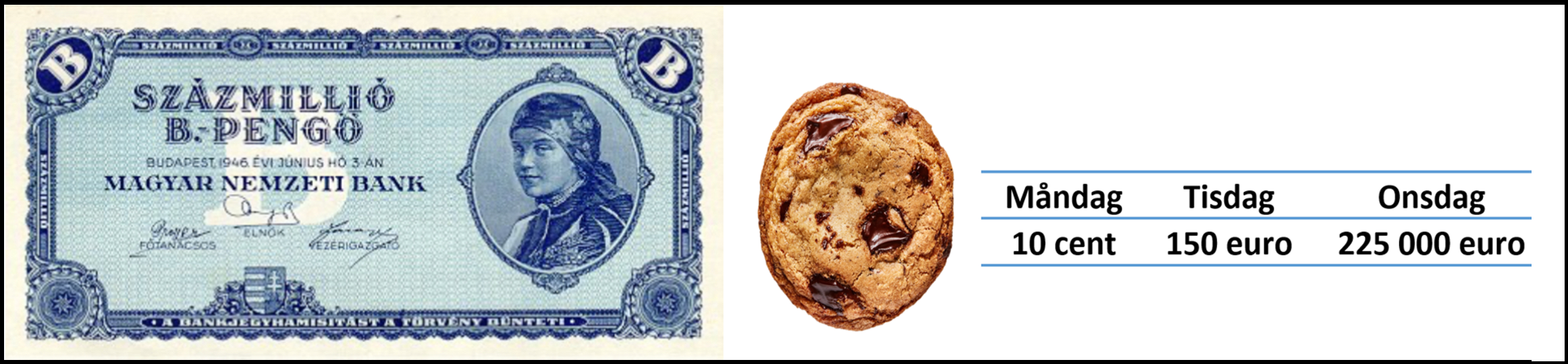
Yes — a biscuit that costs €0.10 on Monday costs €150 on Tuesday and €225,000 on Wednesday. Living in such a society is exhausting. You will spend almost all your waking hours trying not to be cheated (recall menu costs and shoe‑leather costs from the previous chapter). Fortunes are redistributed almost at random and using prices as signals is practically impossible: does the rise in the biscuit price mean people want more biscuits (should I open a bakery?), or is it all just inflation?
This is what the ECB says on its website:
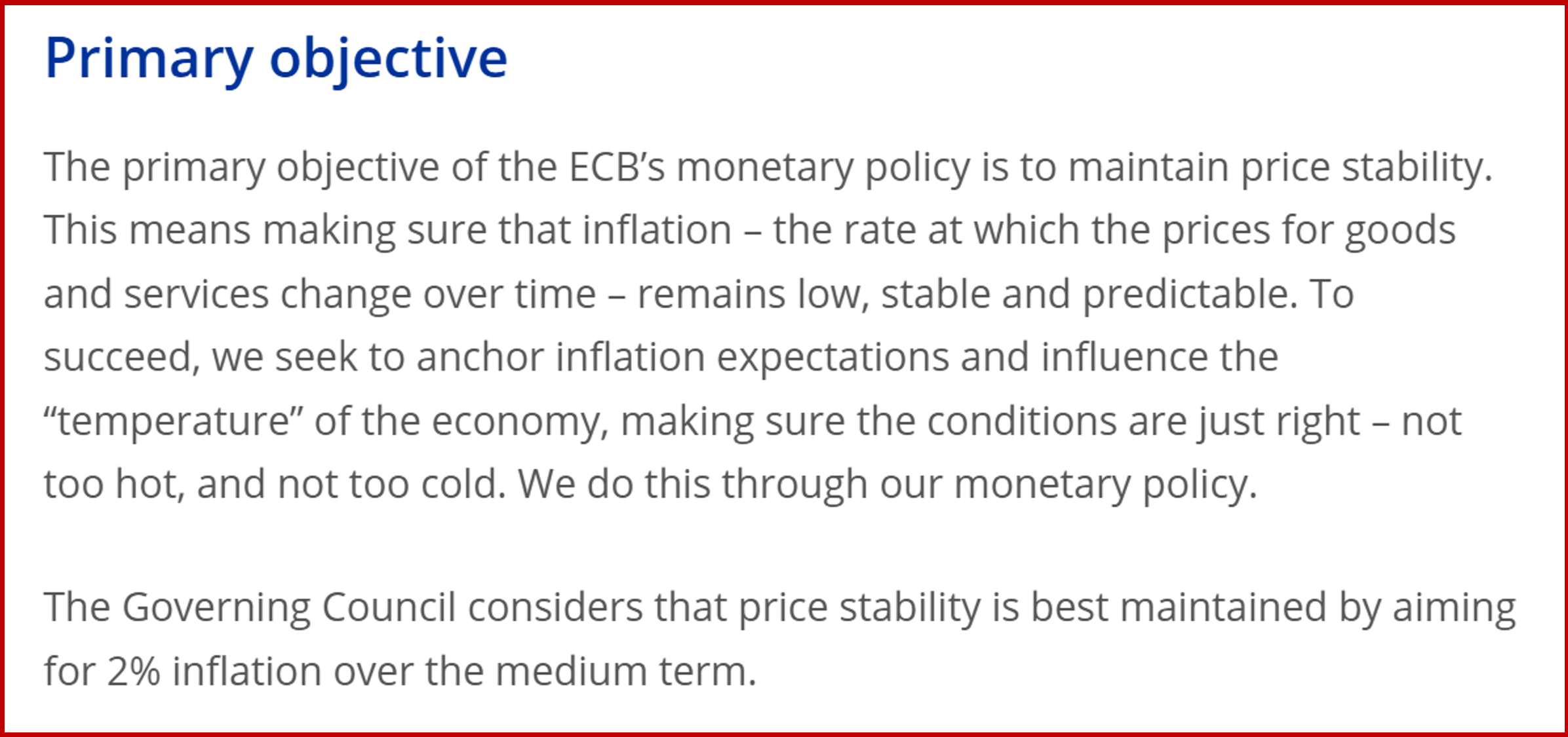
In other words, the ECB aims to stabilise the economy around the long‑run trend, which it does via monetary policy. But why doesn’t the ECB target 0% inflation if inflation is so harmful? There are three reasons the ECB aims for 2% inflation instead of 0%:
1. Less risk of deflation. As you saw in Figure 17.1 the euro area has experienced deflation several times. Falling prices may sound attractive, but deflation is dangerous: the real value of money rises over time, so people postpone consumption (why buy today if things will be cheaper tomorrow?), which collapses AD and can cause severe downturns. Targeting ~2% inflation reduces the risk of accidentally slipping into deflation.
2. CPI likely overstates true inflation. Recall the measurement problems with CPI (quality changes, new goods, substitution). Because CPI tends to overestimate the “true” rise in the cost of living, aiming for 2% CPI inflation may imply actual inflation is closer to 0%.
3. A modest inflation eases real wage adjustments. With some inflation it is easier for firms to reduce real wages without cutting nominal pay — employees’ purchasing power falls less starkly than with nominal wage cuts, making labour‑market adjustments (and avoiding painful nominal wage cuts) politically and economically smoother.
Monetary policy in practice: How is it done?
Christine Lagarde’s objective is thus “stable prices” in the EMU countries, which the ECB interprets as a CPI increase of about 2 percent per year. But what does monetary policy actually mean in practice? This is how the ECB describes it:
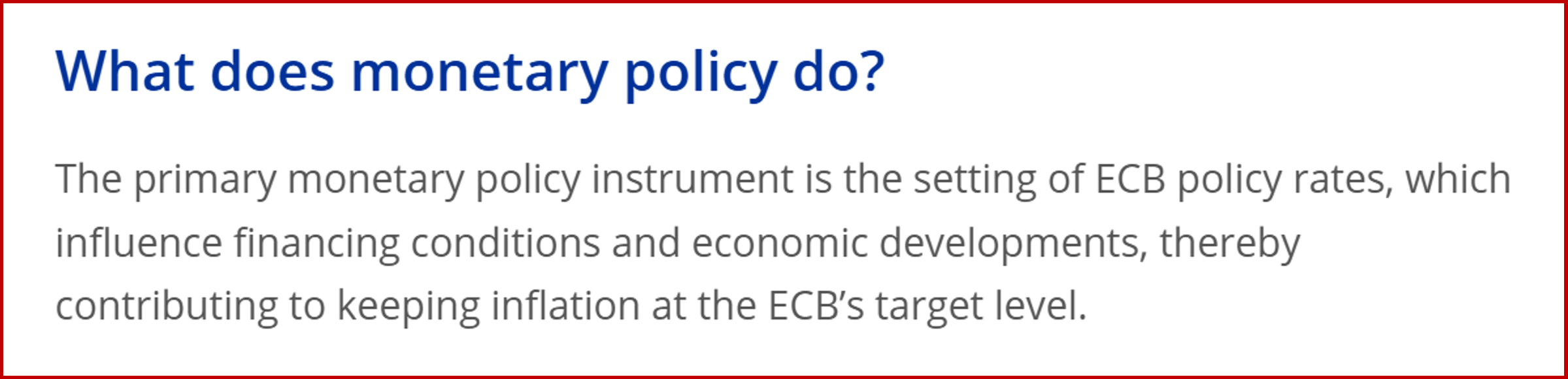
The central bank controls the economy’s “temperature” by influencing the interest rate. Think of Lagarde as having a lever to pull — just as the finance minister can steer the economy by adjusting taxes, transfers and public spending. If prices rise too fast Lagarde can cool things down by raising the interest rate. Higher rates make households consume less and firms postpone investment because borrowing becomes expensive. In bad times Lagarde can cut rates to boost demand.
But how does this work in practice? Although it may seem complex the basic principles are simple. One key insight is that the money supply (which, as we saw in Section 17.7, helps determine the price level) is set by both the central bank and ordinary commercial banks. In other words, banks such as Nordea and Swedbank can create money.
Think back to the stone wheels on Yap to understand how banks create money. Remember what I did?
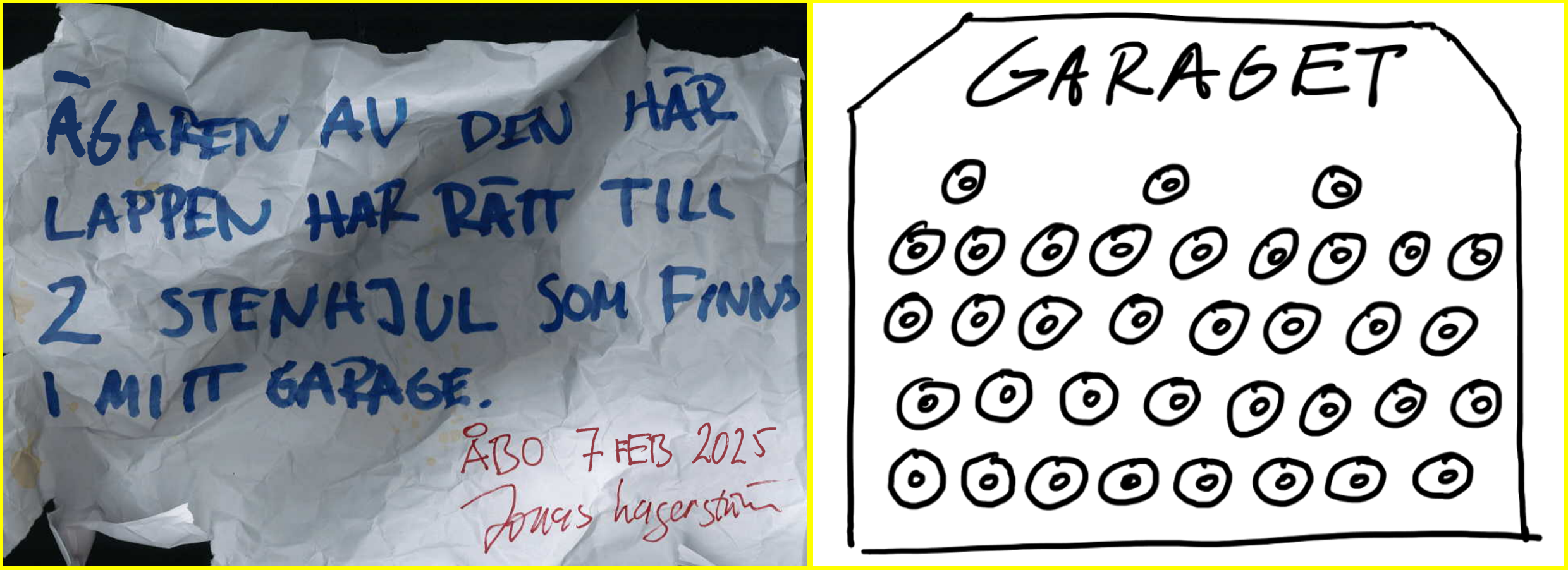
Instead of lugging the stone wheels around on my shopping trip, I paid with a slip. The person who received the slip could in turn use it to pay when they wanted to buy something — or at any time go to my garage and exchange the slip for the stone wheels. But few ever bother to collect their wheels; they usually just sit in the garage gathering dust. That means I could, hypothetically, take some of the wheels and spend them — even though they technically belong to someone else.
This is exactly what banks do. Imagine you are the CEO of Swedbank. Your business idea is brilliant. Many people want to deposit their savings with the bank and accept a 1 per cent interest on their deposits. As CEO you realise it is unlikely that all depositors will withdraw their money at once — so the deposited funds do not need to sit idly in the vault. There are plenty of people who want to borrow! And the bank can charge borrowers a healthy rate. The question is: what share of the deposited funds do you dare to lend out? The more you lend, the higher the bank’s profit (because borrowers pay a higher rate than depositors receive). On the other hand, the more you lend, the greater the risk that the vault will be empty if, against the odds, many depositors suddenly want to withdraw their money.
interest rate is the price you receive for lending your money
the central bank is the state’s or monetary area’s bank, responsible for managing the currency system and maintaining currency stability
the European Central Bank (ECB) is responsible for monetary policy in the euro area
monetary policy is when the central bank regulates the money supply and interest rates to influence aggregate demand; tight policy is used in booms, while expansionary policy is used in recessions
the policy rate is the rate banks pay when they borrow from the central bank; it determines the rates banks in turn set for firms and households and is therefore the central bank’s key monetary‑policy tool
reserve requirement aims to balance the money supply and stabilise interest rates; each bank must hold a portion of its funds with the central bank
What does Swedbank do if the vault is empty? If Swedbank has lent out too much it can borrow from Christine Lagarde at the central bank. The rate Swedbank pays when borrowing from the ECB is called the policy rate. The policy rate is therefore Lagarde’s key tool for influencing how “aggressively” Swedbank and other banks lend. Imagine the policy rate were 500%. Wouldn’t such a high rate make Swedbank far more cautious about lending? Conversely, if Lagarde cuts the policy rate and makes it cheap for banks to borrow, Swedbank will take bigger risks and lend more. In that case it is less catastrophic if the vault is occasionally empty.
The policy rate thus affects the interest you receive when saving and the rate you pay when borrowing. The market for bank loans works like any other market: when many sellers want to offload something (for example when more banks offer loans because the policy rate is low), the price falls — here that means it becomes cheaper for you to take, say, a student loan. If Lagarde raises the policy rate, fewer banks will dare to lend, making it harder and more expensive for you to borrow for, for example, a house purchase.
In practice central banks also have other monetary tools. They can formally regulate how “aggressively” a bank may lend. Through so‑called reserve requirements the central bank dictates what fraction of deposited funds Swedbank must keep on hand. High reserve requirements therefore mean banks cannot lend as much, which pushes interest rates up. Central banks can also affect the money supply by buying and selling financial assets. If Lagarde sells securities for €100 billion, buyers hand over securities and Lagarde receives €100 billion that she can withdraw from circulation. This action reduces the money supply in the euro area and cools the economy.
What happens at the ECB in Frankfurt therefore affects your everyday life. It is no surprise that Christine Lagarde is annually ranked among the world’s most powerful women (Forbes 2025 ranking here).
The Wizard of Oz
In the late 19th century the United States suffered from deflation. Between 1880 and 1896 the price level fell by 23 per cent. This deflation hit ordinary people hard, especially farmers and industrial workers who had borrowed money. The winners were banks and wealthy Americans with large savings. [Why? Think this way: under hyperinflation in Germany savers lost everything while heavily indebted people could repay easily — so the opposite holds under deflation.]
Economic theory suggested that to fight deflation one should get more money into the economy. The problem was that, by law, the supply of dollars was tied to the country’s stock of gold. Every note and coin had to be redeemable for a certain amount of gold. Because the amount of gold in the US was limited, it was therefore impossible for politicians to create more money. The opposition therefore proposed abandoning the strict gold link and allowing money to be redeemable for both gold and silver. That way the money supply could be expanded and deflation overcome.
This is what the film The Wizard of Oz is about. The story follows Dorothy from Kansas, swept up by a tornado to the magical land of Oz. Dorothy (representing traditional American values) is told that only the Wizard (the sitting Republican president) in the Emerald City (Washington) can send her home. The road to the city is paved with gold (symbolising the money–gold link). She is joined by the Scarecrow (the farmer), the Tin Man (the industrial worker) and the Cowardly Lion (the Democratic presidential candidate). In the Emerald City everything is green (the colour of US money), and Dorothy discovers the Wizard is a fraud. The story nevertheless ends happily when she discovers the magical power of her silver shoes (the new monetary policy).

In reality the Republicans remained in power in the US, so the link between money and gold was maintained. The deflation problem was eventually resolved when gold was discovered in Alaska at the end of the century. With more gold the authorities could increase the money supply — and deflation disappeared. Between 1896 and 1910 the US price level rose by 35 percent.
18.2 The Phillips curve
We are now ready to tie things together and show how monetary policy affects the economy. The short‑run relationship between inflation and unemployment is shown in the following figure:
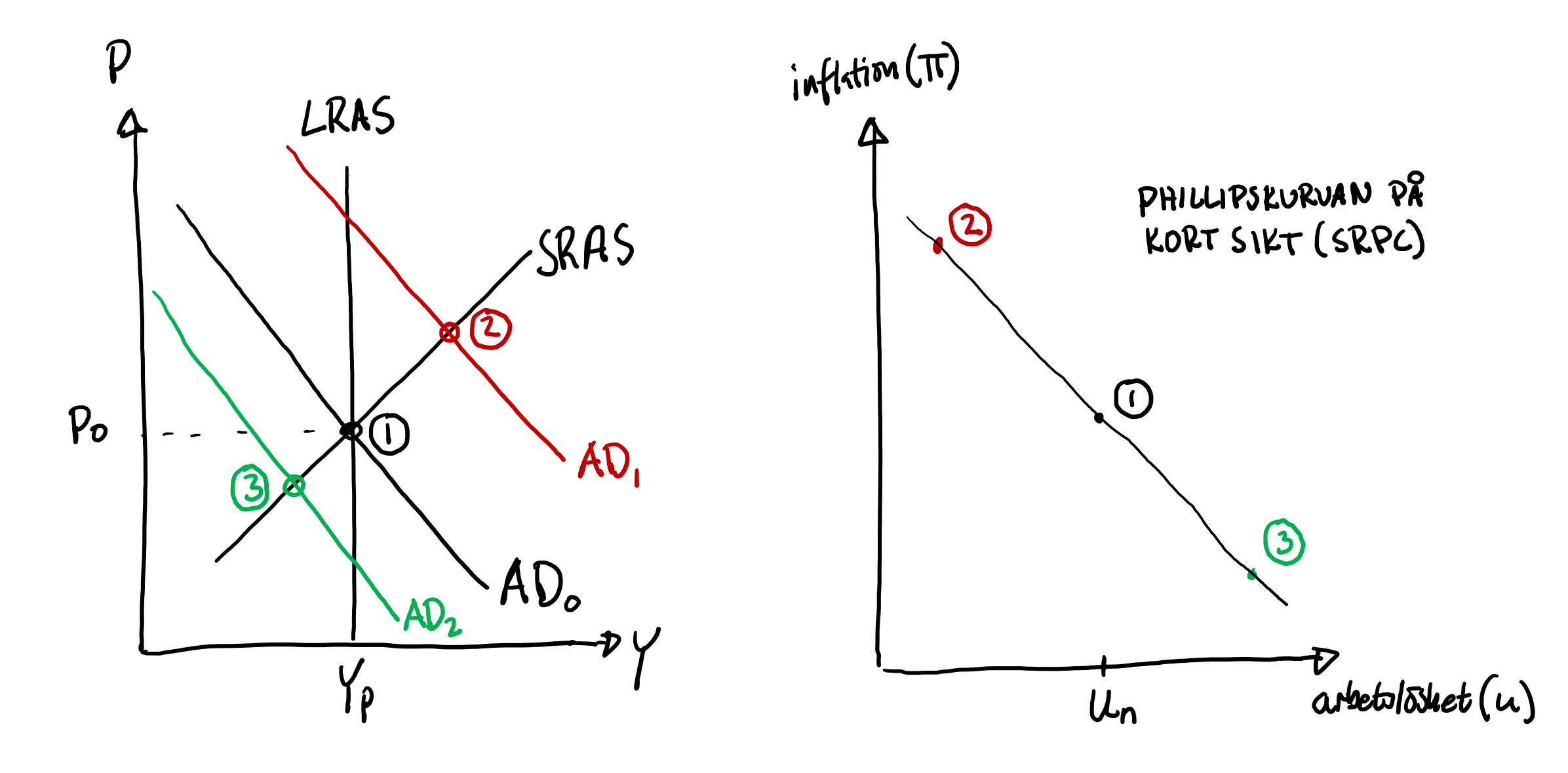
On the left of the figure you see the AD‑AS model. We start at point 1, where the economy is in long‑run equilibrium. To the right I’ve drawn a different kind of chart with inflation on the vertical axis and unemployment on the horizontal axis. In this initial position (point 1) we are in long‑run equilibrium — that is, we are neither in a boom nor in a recession. All unemployment at this point is therefore “natural”; it is the unemployment we can expect in the long run.
Now imagine the central bank pursues expansionary monetary policy, for example Lagarde cuts the policy rate. That makes it cheaper for commercial banks to borrow from the central bank, which encourages banks to lend more. Greater supply of bank loans pushes market interest rates down, which in turn raises household consumption (C↑) and business investment (I↑). Expansionary monetary policy therefore shifts the AD curve to the right. The short‑run result is a higher price level and higher GDP (see point 2 in the figure). What does this correspond to in the right‑hand chart? Inflation is higher and unemployment is lower.
What if the central bank instead conducts tighter monetary policy? Then Lagarde makes it more expensive for banks to borrow from the central bank, which makes banks in Finland more cautious about lending. This results in higher interest rates and falling AD. In the short run both the price level and GDP fall in the AD‑AS model (point 3). In the right‑hand figure this corresponds to lower inflation and higher unemployment.
Look at this Phillips curve (the Short‑Run Phillips Curve, SRPC). What does the curve mean in practice? It shows there is a short‑run trade‑off between inflation and unemployment. When William Phillips discovered the relationship in 1958 it caused a stir: he showed that a country could — at least in the short run — choose between lower unemployment and higher inflation, like picking from a menu.
Do you think high unemployment is the greatest economic problem? If so, policy should aim for point 2 in Figure 18.1. Expansionary fiscal and monetary policy can push unemployment below the natural rate. The downside is higher inflation, but you might accept that if unemployment is your main concern.
If, instead, you view high inflation as the chief threat, steer the economy toward point 3. Tight fiscal and monetary policy will keep inflation low. The cost is higher unemployment — but you just said low inflation is the priority.
But doesn’t this seem too good to be true? According to the AD‑AS model there is no long‑run link between the price level and GDP. Can there really be a permanent trade‑off between inflation and unemployment? The answer is no. Here is the long‑run relationship between inflation and unemployment:
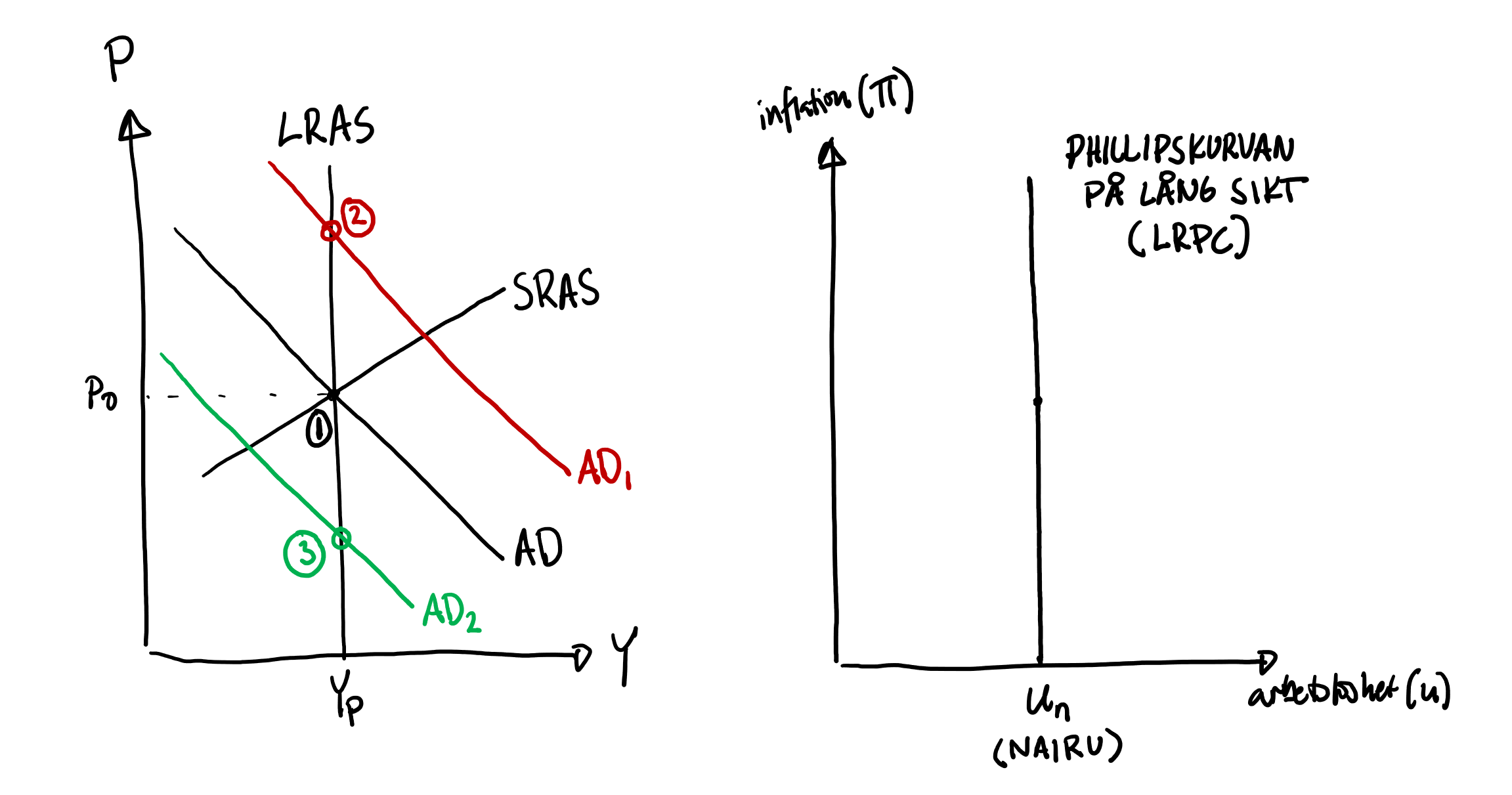
We know expansionary policy can push the economy into a short‑run boom. But in the long run the economy returns to potential GDP (from point 1 to point 2 in the figure above). That means expansionary policy can only temporarily reduce unemployment. Over time unemployment returns to its natural level. The only long‑run effect of our stimulus is higher prices and higher inflation. Hence the long‑run Phillips curve (Long‑Run Phillips Curve, LRPC) is vertical. Using expansionary fiscal or monetary policy to push unemployment below the natural rate only causes inflation to accelerate in the long run. The natural rate of unemployment is therefore often called the NAIRU (Non‑Accelerating‑Inflation‑Rate‑Of‑Unemployment).
The Phillips curve states that when unemployment falls inflation rises and vice versa; the relationship probably holds only in the short run
the natural rate of unemployment is the idea that the economy is drawn to a particular unemployment rate in the long run (the NAIRU); if policymakers push unemployment below this level it can lead to overheating as wages and prices accelerate; read more here kan du läsa mer
18.3 The importance of credibility
Modern macroeconomics is largely about influencing people’s expectations. We will soon look at how Venezuela could go about reducing inflation and saving the country. But first a few analogies!
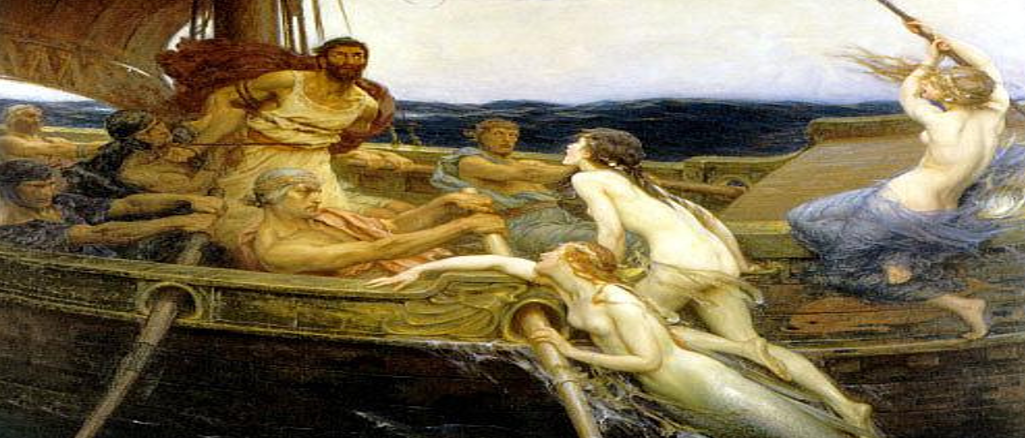
1. Odysseus must sail past the Sirens’ isle. Odysseus is returning home after years of war and must get past the Sirens. The Sirens sing so beautifully that sailors go mad and throw themselves into the sea to drown. Odysseus realises his only chance is to have himself tied to the mast while his crew plugs their ears with wax. That way they all get home safely. Odysseus survives by limiting his freedom; he becomes powerful by giving up his power.
2. Aircraft hijackings. In September 1972 far‑right Croatian extremists hijacked a plane between Gothenburg and Stockholm. Their demands were that seven compatriots sentenced to death be released and that the plane fly them to freedom in Spain, along with SEK 500,000 in cash. The Swedish government accepted the terrorists’ demands, despite having always said they would never negotiate with terrorists. The thought of 90 dead Swedes was too much. In the short run it ended happily. In the long run, however, the politicians sent a dangerous signal to terrorists worldwide that hijacking pays.

3. Education at Åbo Akademi. A large part of universities’ revenue depends on student success. For example, ÅA receives about €500 each time a student passes a course. The sum increases substantially if the student also follows the recommended study pace. These financial incentives are meant to encourage universities to provide good teaching.
But almost every reform has unpleasant side‑effects. Do you see the danger in ÅA getting paid every time a student passes a course? If all 250 students on this course pass the exam, ÅA would receive roughly €125,000. That would make me popular with my boss (and I’d also avoid re‑marking resits and disappointing students).
As a teacher I know that good results on this course help you later in your studies. I also know that employers value your mastery of the subject. That is why I always stress the importance of working hard. The problem is that I am not credible. Why? Because you realise I have everything to gain from making the exam easy so everyone passes.
Since the exam will likely be easy, it is rational for you not to study much. The end result can therefore be that no one studies and no one learns anything — yet everyone still passes with high grades. In the short run this is a happy ending for us all. But what happens next term or on the first day in the labour market?
The problem in both the hijacking case and in education was a lack of credibility in policy. Terrorists knew politicians would give in under pressure, and students knew Jonas Lagerström would cave. But Odysseus survived the Sirens! Can we use his lesson?
Imagine instead the course is graded by a notorious Harvard professor. Rumour has it he delights in failing students. Moreover, the professor has tied himself to the mast: the exam is graded by a computer to which only the President of Finland has access. Letting through students who do not meet the learning objectives is therefore physically impossible. According to credibility theory this exam setup would make you study more. Many hours of study will likely produce high grades. A strong start helps you succeed later in your studies — which in turn leads to success in the labour market.
All this happens thanks to the nasty professor. In the same way an incorruptible politician might convince terrorists that hijacking pays nothing. And in monetary policy a tough, independent central‑bank chief — uninfluenced by short‑term political interests — might convince people that inflation will indeed be kept under control.
18.4 Independent central banks
You are hereby appointed president of a small country where you personally control monetary policy. From your economics studies you remember that high inflation is problematic. In your inaugural speech you therefore proudly declare:
»Inflation will be 0 percent!«
The country’s residents trust your fine words. Because they do not expect any inflation they accept small nominal wage increases and Fabbe at the café keeps his prices unchanged.
But after a while the temptation becomes too great. You recall that expansionary monetary policy can produce a boom. So you cut the policy rate (and lower reserve requirements and buy financial assets), which raises aggregate demand. In the short run incomes rise and unemployment falls — but inflation also begins to pick up.
In practice most people understand that politicians find it hard to resist the temptation to use expansionary policy. There is therefore a high risk they will, “just to be safe”, demand large nominal wage increases. In the same way Fabbe is right to raise his prices. The lesson is this: Expectations about inflation become a self‑fulfilling prophecy. If you believe there will be inflation, inflation will occur!
This explains why many central banks today are independent. It is economists — not politicians — who decide how high the interest rate should be. No politician can tell Christine Lagarde what to do with interest rates in the euro area; she has full freedom to do exactly as she pleases during her eight‑year term and cannot be dismissed even if politicians are unhappy.
Independence has been shown to lead to lower inflation — which is good for all of us. But how should that advantage be weighed against the drawback that voters cannot directly influence who sets interest rates? Critics argue it is unreasonable that economists have such great power. What do you think?
The US brings down inflation in 1981
The 1970s were a troubled time in the US, marked by Watergate and the Vietnam War. Another major problem was high inflation. Each year the general price level rose by 5–15 percent. Inflation imposed large costs on Americans, and it became ever clearer that inflation had to be brought down.
To tackle the problem the president appointed Paul Volcker as central‑bank chief. Volcker had made his career on a reputation for strong resistance to inflation. In speech after speech he made it clear that as central‑banker he would not care one whit if US unemployment rose.
»The era when the central bank rescues the US from recessions is over forever!« he thundered.
Central‑bank chiefs had always said things like this, of course, but when crises hit they usually gave in. Volcker was different. He was known for being ruthless. Some critics even claimed he took pleasure in seeing people lose their jobs.
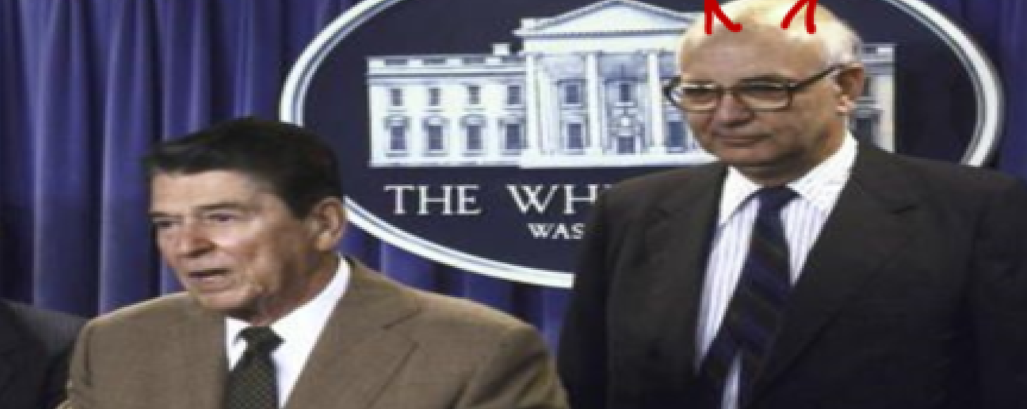
Volcker then set about fighting inflation by sharply raising the policy rate. Banks followed by hiking their lending rates. Suddenly borrowing was expensive and saving attractive. Aggregate demand fell, which cooled prices. The cost was that the US was thrown into a recession and unemployment rose sharply.
Normally authorities would have backed down in such a situation and yielded to the protests. This time it was different. Americans soon realised Volcker meant business — he truly would not rescue them from the downturn by returning to an expansionary stance. Once Americans expected low inflation, inflation became low. It did take a recession to break inflationary expectations, but the crisis turned out shorter and milder than critics had feared.
Trump attacks the central bank
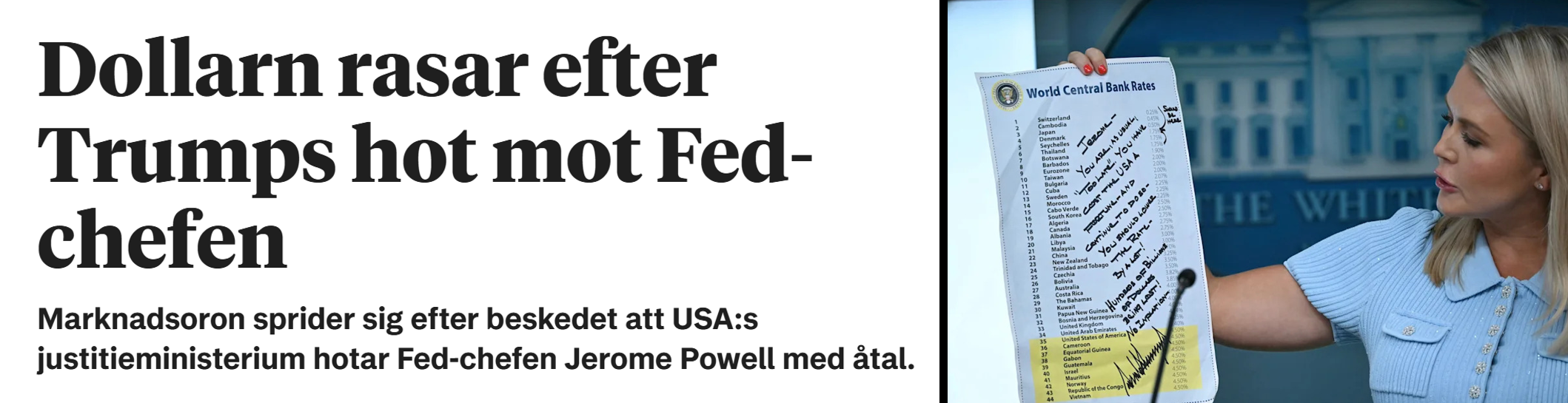
“Jerome, you are, as usual, too late. You have cost the USA a fortune and continue to do so. You should lower the rate by a lot. Hundreds of billions of dollars are being lost and there is no inflation.”
- President Donald Trump attacks FED chair Jerome Powell
In recent months President Trump has stepped up his criticism of the US central bank and its chair Jerome Powell. The problem, according to Trump, is that the policy rate should be cut much more than the Fed has done so far. In the clip below you can learn more about the conflict — and what it might mean for the global economy in the long run:
How Venezuela can beat inflation
What advice would you give the authorities in today’s Venezuela? First, they must stop financing deficits by printing money. They will probably also need to raise the policy rate to reduce the amount of money banks can create. With less money in circulation interest rates will rise. The risk is this further suppresses demand and deepens the crisis in the short run. But once inflation expectations fall, prices and inflation will decline, GDP will return to potential and unemployment to its natural rate.
The difficulty is that people in Venezuela lack trust in their politicians. Imagine the president gives a televised speech:
»Inflation has been a million percent per year in recent years. We now realise that was not a good idea. Next year inflation will be 0 percent.«
How will people react? My guess is they will say something like:
»Yes, yes… you always say that (malditos idiotas!) and then prices rise by a million percent anyway! I will therefore continue to demand at least a one‑million‑percent nominal wage rise and I will keep raising all prices in my shop.«
The danger is that Venezuela may need to endure a deep, prolonged recession — a “cleansing” — before the population is convinced that inflation will actually be kept down. The big challenge for Venezuela is therefore to build a society the population trusts.
In practice changing people’s expectations has proven very difficult and can be extremely costly in the short run. If a school wants to eliminate grade inflation and only pass students who meet the knowledge requirements, many students may fail in the short term. Being the first justice minister to refuse to negotiate with terrorists can lead to bloodshed initially. As in economic policy more generally, short‑term effects are often very different from an action’s long‑term consequences.
18.5 Keynes and modern macroeconomics
John Maynard Keynes revolutionised the view of economic policy when in the 1930s he advocated that the state should steer the economy using fiscal and monetary policy. We have seen that such policy affects real variables — purchasing power and unemployment — only in the short run. In the long run it affects only nominal variables such as prices and wages.
You have also learned that expectations are crucial in macroeconomics. Some macroeconomists argue that people are rational. That would mean you do not only react to the past but can use all available information to predict the future. What would you do, for example, if you were completely sure that Lagarde tomorrow would create 30 percent inflation? Perhaps she hopes to lure the euro area into a blistering boom and end her term on a high note?
You would probably immediately use that information in wage bargaining and price setting. If everyone is equally clever and rational, all prices and wages would rise by 30 percent instantly — yet neither GDP nor unemployment would be affected even in the short run.
These monetarists therefore argue that it is usually futile for the government to try to fine‑tune the business cycle. They contend that policy should instead focus on keeping inflation low and on improving the economy’s long‑run prospects. Such supply‑side policy typically aims to reduce the natural rate of unemployment and implement reforms that speed up long‑term economic growth.
Exercises
In this chapter you have learned more about how inflation can be fought with economic policy. Below are some cases where you can apply your knowledge in practice. Press Show Answers when you want the computer to mark your answers. Good luck!
The struggle between Keynes and the classicals
Modern macroeconomics was born in 1936 when John Maynard Keynes introduced a completely new way of viewing the economy. Instead of trusting the market as the classical economists did, Keynes argued that the state must take a much more active role in the economy. The battle between these two camps has shaped macroeconomics and economic policy ever since.
- The ECB’s objective is for inflation in the EMU area to be around .
- If the ECB raises the policy rate this will, in the short run, lead to and .
- The natural rate of unemployment consists of the sum of frictional unemployment, structural unemployment and .
- If the US central bank (the Fed) buys large amounts of financial assets the likely short‑run effects are that interest rates , GDP , unemployment and inflation .
- Unemployment in Europe has historically been higher than in the USA. Give three credible explanations for why equilibrium unemployment may have been higher in Europe than in the USA.
- Give three concrete examples of supply‑side policy.
- According to the short‑run Phillips curve, when the government raises taxes this leads to .
- The reason the ECB has sharply raised the policy rate in recent years is to .
- The short‑run effect of expansionary monetary policy is .
- In the battle between Keynes and the classicals I side with . Write three sentences summarising the opposing side’s best arguments.
- Read the chapter.
- Start from Figure 18.1: higher interest rates reduce C and I, shifting AD left. The effect is lower GDP and a lower price level. On the Phillips curve this corresponds to moving along the curve toward higher unemployment and lower inflation. Be prepared in the exam to draw and explain the Phillips curve.
- Read the chapter.
- When the US Fed buys securities more money enters the economy, which lowers interest rates (a larger supply of loanable funds reduces their price). Lower rates shift AD right, so GDP rises (AD‑AS) and unemployment falls while inflation rises (Phillips curve).
- Begin by explaining that equilibrium unemployment consists of frictional, structural and classical unemployment. Then give plausible reasons why these components may be higher in Europe than in the US: e.g. lower geographic mobility, weaker retraining systems, more generous benefits, stronger unions and higher entry wages (efficiency‑wage effects).
- Supply‑side policy focuses on the supply side: raise potential GDP and reduce the natural rate of unemployment. In your answer mention growth‑theory recommendations and concrete measures to lower the natural unemployment rate (education, labour‑market reforms, incentives for investment, etc.).
- Higher taxes move us from point 1 to point 3 in Figure 18.1 in the short run.
- The ECB raising the policy rate likewise moves us from point 1 to point 3 in Figure 18.1 in the short run.
- Expansionary monetary policy stimulates the economy: lower rates take us from point 1 to point 2 in Figure 18.1 in the short run.
- Watch at least one of the films and try to understand it deeply. Ultimately the debate is about trust in markets versus trust in policy: if you distrust markets but trust politicians you may lean Keynesian; if the opposite, you may lean classical.
Who controls the money?
In the postwar era some central banks have been politically controlled while others have been more independent. Some argue that independent central banks lead to lower inflation.
- The chart above shows that countries with more independent central banks have on average experienced inflation than countries with more politically controlled central banks.
- Why would politically controlled central banks lead to higher inflation? A YLE article on the clash between President Trump and Fed Chair Powell can be read here.
- Central‑bank independence is by no means obvious. Give one argument against making central banks independent.
- Read section 18.4. Remember this is a big question: should ordinary citizens be able to influence who controls monetary policy, or should that power be handed to unelected economists?
- Read section 18.4.
- Read section 18.4.