9 But asymmetric information?
(where you learn why markets fail when you know more than I do)
You stand in the middle of the Market Square, angry as a hornet. Not only have you discovered that some market parties have more power than others — which, as we saw in Chapter 7, helps explain why iPhone earbuds cost €180 and why youths earn pitiful wages — you also learned in Chapter 8 that externalities lead to too much booze and too little public art.
Now you’ve furthermore discovered that your employees sleep on the job and that it’s impossible to sell your used Toyota Corolla Verso. Neither the labour market nor the used‑car market is working! Both examples illustrate market failures caused by asymmetric information, meaning one party in the market knows more than the other. You will soon see that asymmetric information can explain everything from exorbitant insurance premia and welfare fraud to sky‑high CEO pay and the origins of financial crises. Let’s get started.
asymmetric information, or private information, means one party in the market knows more than the other party; for example, the seller of a used car knows more about the car’s condition than the buyer
9.1 Adverse selection
Asymmetric information leads to two unpleasant phenomena: adverse selection, which arises when one party knows more about how something IS, and moral hazard, which arises when one party knows more about what someone DOES. Let’s begin by understanding adverse selection. We do this by observing what happens around the Market Square.
adverse selection arises because one party knows more than the other about how something IS.
Buffet lunch market at the square
You run a lunch restaurant near the Market Square in Turku. You now want to launch a lunch buffet. However, you know there are two types of potential customers: “good” and “bad.” The good customers eat relatively little — on average only €5 worth. The bad customers, by contrast, have an almost insatiable appetite and consume about €15 worth. Unfortunately you cannot tell in advance whether a customer is good or bad.

| Good customers | Bad customers |
|---|---|
| Cost: €5 | Cost: €15 |
Assume Finns are 50% good customers and 50% bad customers. What price should you set for your lunch buffet? What happens if you set the price at €10? That is exactly what the typical customer would consume, right? No! Put yourself in the good customer’s shoes: why would she pay €10 when she only eats €5 worth? The conclusion is that the good customers will never come to your restaurant. Instead you attract the customers who are worst for your business — and you must therefore set the buffet price at €15. Do you see the market failure? There will be no buffet available for people with moderate appetites.
The used‑car market
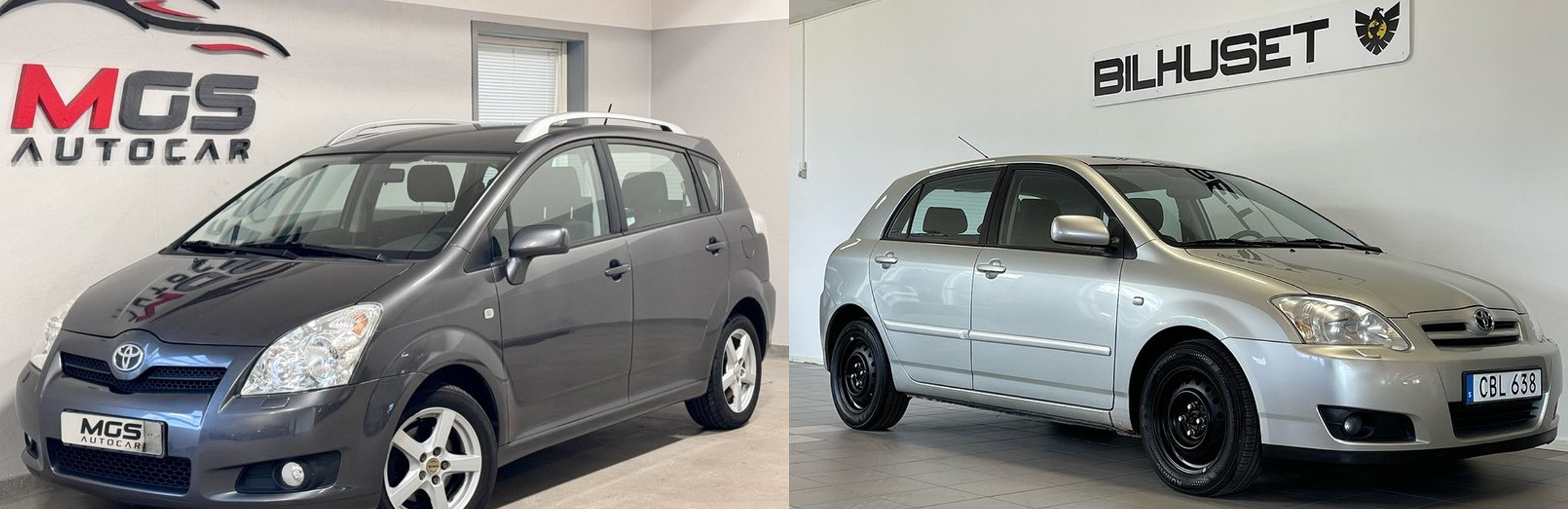
You want to buy a used Toyota Corolla Verso. But you know there are two kinds of cars: good and bad. Good cars are worth €10,000, bad ones only €1,000. Unfortunately you cannot tell in advance whether a given car is good or bad.
| Good cars | Bad cars |
|---|---|
| Value: €10,000 | Value: €1,000 |
Assume half the used cars are good and half are bad. What price would you pay for a car? Perhaps €5,500 — that’s what the “typical” car on the market might be worth, right? No! Put yourself in the owner of a good car’s shoes: why would she sell a car worth €10,000 for €5,500? The conclusion is that good cars will never be offered for sale. Because buyers understand that every car on the market must be bad, the price falls to €1,000. Do you see the market failure? There will be no trade in good used cars.
The labour market
You want to hire an analyst with an interest in economics and society. But you know there are two types of workers: good and bad. Good workers are worth €4,000, bad ones only €1,000. Unfortunately you cannot tell in advance whether a worker is good or bad.

| Good workers | Bad workers |
|---|---|
| Value: €4,000 | Value: €1,000 |
Assume half of Finnish workers are good and half are bad. What wage would you pay a hire? Maybe €2,500 — that’s what the “typical” worker on the market might be worth, right? No! Put yourself in the good worker’s shoes: why would she sell herself for €2,500 when she knows she’s worth €4,000? The conclusion is that good workers will never offer themselves for hire. Instead only bad workers are hired — and the wage falls to €1,000. Do you see the market failure? There will be no trade in good workers.
The market for smartphone insurance
You are CEO of the insurance company If. You now want to sell a student insurance that covers the cost when a smartphone is damaged or lost. But you know there are two types of students: good and bad. The good students are careful and take good care of their smartphones. That means If rarely has to buy new phones for this customer group; on average good customers cost only €50. The bad students are careless. Losing a phone at a bar or smashing the screen on the pavement is more the rule than the exception. A bad student typically costs If €250 per year, but unfortunately If cannot tell in advance whether a student is good or bad.

| Good customers | Bad customers |
|---|---|
| Cost: 50 euros | Cost: 250 euros |
Assume half of students are good and half are bad. What premium should If charge for the student insurance? Maybe €150 — that’s what the “typical” student would cost If, right? No! Put yourself in the good student’s shoes: why would she buy insurance for €150 when her expected cost for a new smartphone is only €50? The conclusion is that good students will never buy the insurance. Instead only bad students will purchase it — and the premium will therefore be set at €250. Do you see the market failure? Careful students end up unable to buy insurance.
Let’s think through what actually happened in the four cases above. In all cases adverse selection occurred — the market ends up consisting only of a bad selection. The buffet serves only gluttons. The used‑car market sells only junk. The labour market ends up with low‑performers only, and insurance is sold only to high‑risk customers. Other groups are pushed out of the market — or they participate only at the wrong prices. For example, if you are a high‑performer who generates large value for your employer, you may of course get a job, but only at a wage that is unreasonably low given your talent.
Why does this happen? Because one party in the market knows more than the other about how something IS. You know you are highly productive, but the employer does not know that at the job interview. Thus wages are set to reflect “expected” productivity, which drives the best workers out of the labour market; once they leave, expected productivity falls and wages fall further. The same mechanism pushes good cars off the used‑car market, as well as moderate buffet diners and careful students who look after their phones. Who wants to buy life insurance? The dying. Who wants health insurance? The sick. Who wants accident insurance? The accident‑prone.
How to solve the problem of adverse selection?
Market participants therefore often find creative ways to handle adverse selection. After all, it is possible in practice to buy a good used car and many capable workers do get jobs with wages that reflect their productivity. How does that happen? If the problem arose because one party knows more than the other and exploits that for private gain, a logical solution is to improve information so both parties know equally much about how something is or to prevent the better‑informed party from profiting by exploiting the information advantage. There are many clever ways to work around adverse selection. In the table below I have listed some examples. Can you think of even more and better ones?
| Insurance market | Labour market | Used‑car market |
|---|---|---|
| fill in health questionnaire | rigorous interviews | history report |
| veterinarian certificate required | tests during interview | independent expert review |
| no rescue dogs | references | educate customers |
| experience rating | probationary hire | sites with ratings and reviews |
| make mandatory | credible university degree | warranty |
For example, see how the insurer learns about its customers. Before you can take out pet insurance you must disclose a lot about your life. You are required to fill in information about both yourself and your dog. The insurer will probably also demand an independent veterinary certificate confirming the dog is healthy. If you have been a customer before, your past behaviour will affect the price you must now pay. All this is done so the insurer can distinguish good from bad risks, allowing it to charge high premiums for high‑risk customers and low premiums for low‑risk customers. This explains why you likely pay more than I do for car insurance (23‑year‑olds drive worse on average), why women may pay more for life insurance than men (women live longer on average), and why owners of older dogs must pay more for pet insurance (older dogs have more health problems on average).
Firms likewise try to learn more about job applicants. Hiring the wrong person can have dire financial consequences for a company, so firms are willing to spend substantial resources to learn about candidates. Note that a credible university degree plays a central role in employers’ hiring decisions. But what does it mean for your degree to be credible? Let’s take a closer look at that.
Signalling model: Why an ÅA degree can earn you a high salary
As we saw in Figure 4.1, Finns with a university degree earn about twice as much as Finns without one. Several studies show that education does lead to higher wages. But why do you get a higher wage after completing a university degree? The traditional explanation is that education makes you more productive, and firms are willing to pay high wages to people who generate large revenues for the company.
There is, however, an intriguing alternative explanation for why a degree raises your wage.
To understand the signalling theory (Nobel Prize in Economics 2001) let’s pretend some people are lucky enough to be born with a trait called ZUPER while others are not. Firms love employees who have ZUPER. These people are simply incredibly productive and a goldmine for the firm. The problem is that at a job interview it is impossible to tell whether an applicant has ZUPER. That means applicants who lack ZUPER tend to lie and claim they have it, which makes you — someone who actually has ZUPER — furious.
»I wish so much there were a way for me to prove to you that I have ZUPER« you mutter to the hiring manager during the interview.
»There is!« replies the manager. »It turns out that applicants without ZUPER have great difficulty completing higher education. If you succeed in earning a bachelor’s degree at Åbo Akademi you will convince me you have ZUPER«.
So you enrol at Åbo Akademi and spend three years at university. You learn absolutely nothing and you do not become one bit more productive than before, but with the diploma in your hand you nonetheless get the job and half a million euros extra in pay.
Does it matter whether you get the high wage because education made you more productive or because education merely served as a credible signal that you were talented already at 18? For you it probably doesn’t matter much — you can happily accept the high wage without caring too much about why employers pay you so well. For society at large, however, it matters enormously. If education truly raises wealth, it is a good investment for the state. If education merely functions as a signal of pre‑existing ability, then it is a gigantic waste that large parts of the population must spend many years grinding toward a diploma. What do you think? In an exercise at the end of the chapter you will reflect further on signalling theory.
9.2 Moral hazard [behavioral risks]
The other phenomenon caused by asymmetric information is called moral hazard, which arises when one party knows more about what someone DOES. To understand moral hazard we return to the Market Square in Turku.
moral hazard arises because one party knows more than the other about what someone DOES.
Insurance, smartphones and the 2008 financial crisis
You have taken out a student insurance policy with If. It’s a lovely day! If something happens to your smartphone you will get a brand‑new phone from If. But suddenly something odd happens: your behaviour changes. You remove the protective case and start shoving the phone carelessly into your back pocket. Over the weekend you go swimming in the river without first leaving the phone on shore. What has happened? You know that any damage will be covered by the insurance, so it costs you nothing if the phone breaks or is stolen. The party that pays — the insurer If — has no idea what you actually do with your smartphone. This is a classic example of moral hazard, where a safety net in the form of insurance leads to changed, less responsible behaviour.

The same phenomenon lay behind the financial crisis in 2007-2008. Many banks and financial institutions took on excessive risks because they expected the government to bail them out in case of large losses. That expectation led them to invest in extremely risky assets, such as subprime loans. When those assets ultimately proved worthless, the entire world was plunged into a deep economic crisis.
Work, sleeping on the job and CEO pay
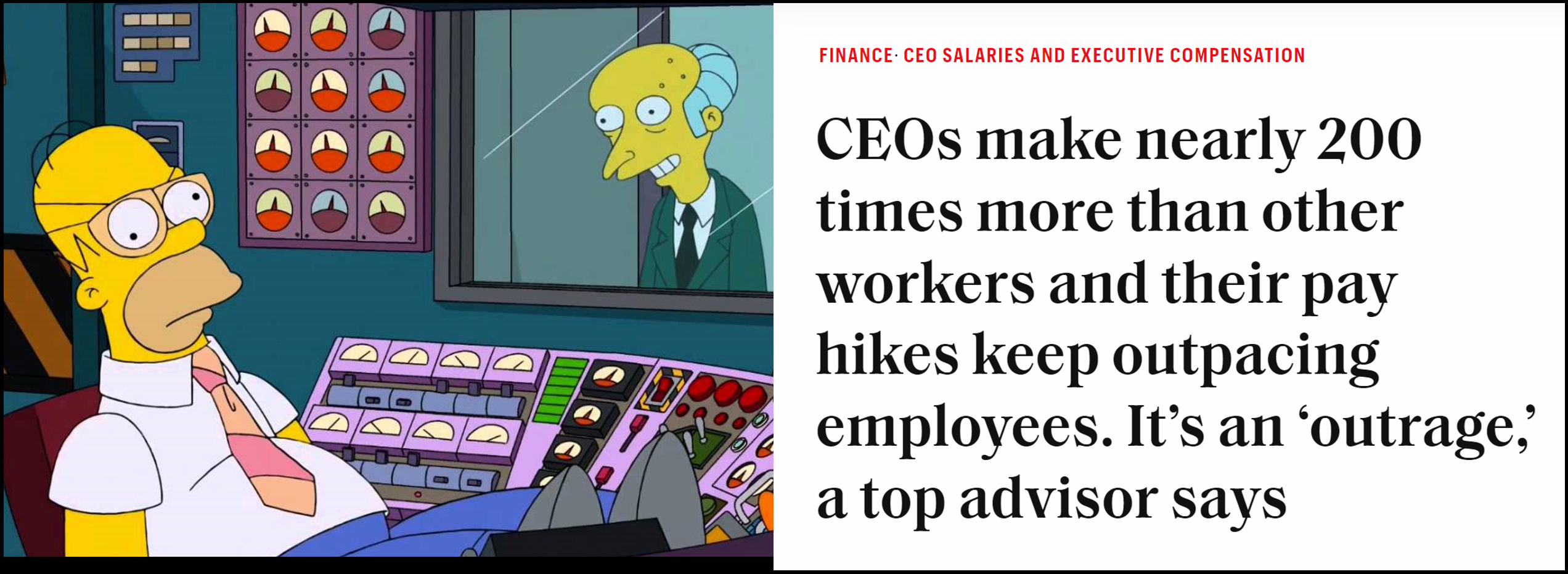
You have just been appointed CEO with a monthly salary of €21,000. It’s a lovely day! But now an interesting moral‑hazard issue arises. Because the shareholders and the board cannot monitor every minute of your workday, there is a risk you become less productive. You start taking extra‑long lunches and leave at 4 p.m.
The same phenomenon arises in many situations where the worker knows more about what they do than the employer can observe. Have you hired a tradesperson, a car mechanic, a lawyer or an estate agent? How do you know they’re actually working hard for their pay? As a client it’s almost impossible to supervise every step they take, and it’s difficult to know everything about drying out a basement, replacing a drive shaft, running a criminal case, or finding prospective buyers. Studies have shown, for example, that real‑estate agents get higher prices when selling their own houses than when selling houses for their clients. At the very end of the chapter there is a one‑minute video that explains the phenomenon.
How to solve the problem of moral hazard?
Moral hazard can also be addressed by improving information so both parties know equally much about what someone does or by making sure the better‑informed party cannot profit from exploiting that advantage. There are many clever ways to work around moral hazard. In the table below I have listed some examples. Can you think of even more and better ones?
| Insurance market | Labour market |
|---|---|
| increased information and monitoring | increased information and monitoring |
| deductible | performance‑based pay |
| waiting period in sick insurance | bonus systems |
| behavioral requirements | profit sharing |
| education and support | reputation and brand |
Thanks to the internet it’s easier than ever to find out how someone behaves. Another way to reduce moral hazard is to make it less profitable to exploit an information advantage. For example, an insurer can introduce a deductible so you pay part of the cost if you lose your smartphone. Likewise, policymakers can introduce waiting periods in public insurance schemes so you receive no benefit for the first days of sickness or unemployment.
In the labour market you can design clever pay schemes that make it worthwhile for employees to work hard. This helps explain why many top executives have a “low” base salary but large bonus opportunities or profit‑sharing. That way owners incentivise managers to give their best for the firm.
Many studies have examined moral hazard. They often find that people’s behaviour is influenced by the size and design of compensation. Three examples are shown here:
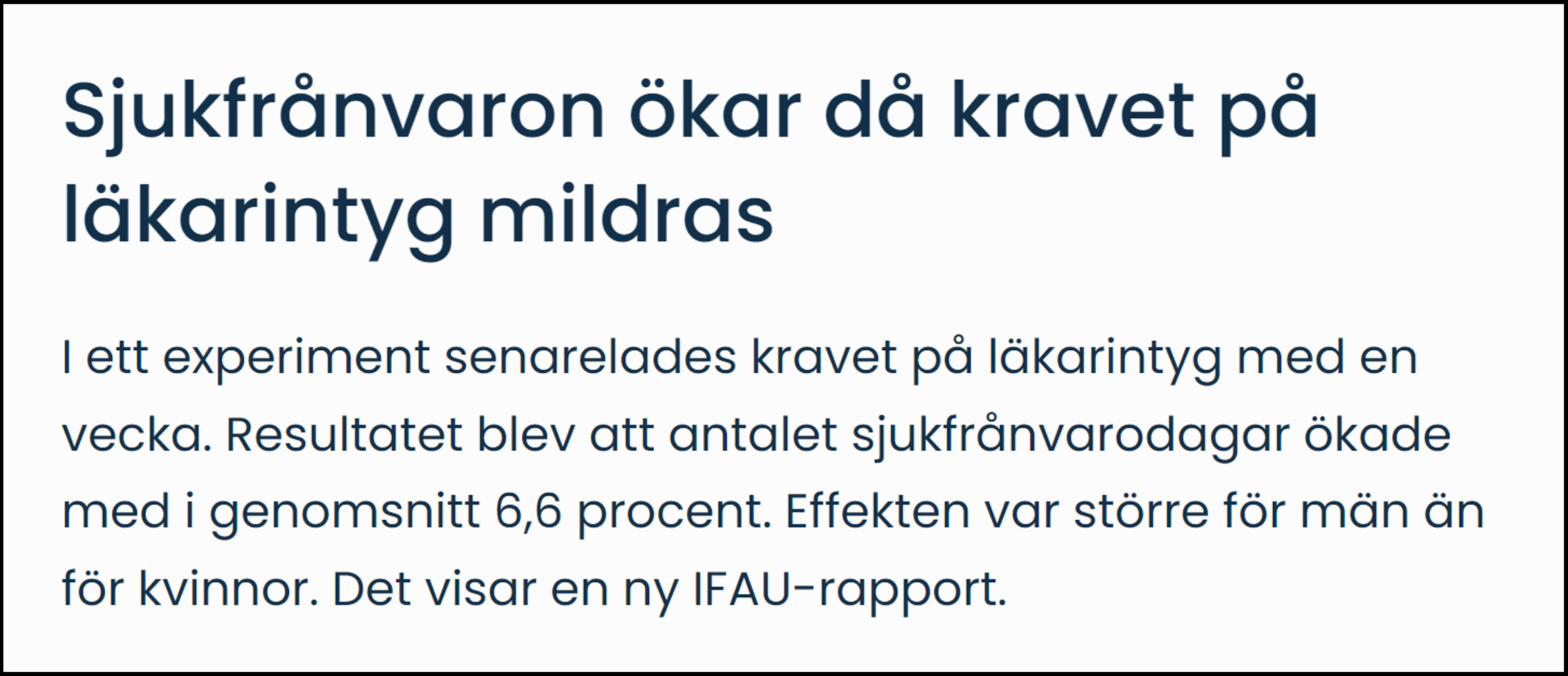
By reducing controls, sick leave increases — especially among men.
Carling et al. (2001) follow thousands of unemployed Swedes. In Figure 9.3 you can see what happened. The horizontal axis shows weeks since becoming unemployed and the vertical axis the share of people who find a job each week. Half the group received unemployment benefits (A‑kassa), half did not. Benefits were paid for only 14 weeks, after which the payments stopped entirely.
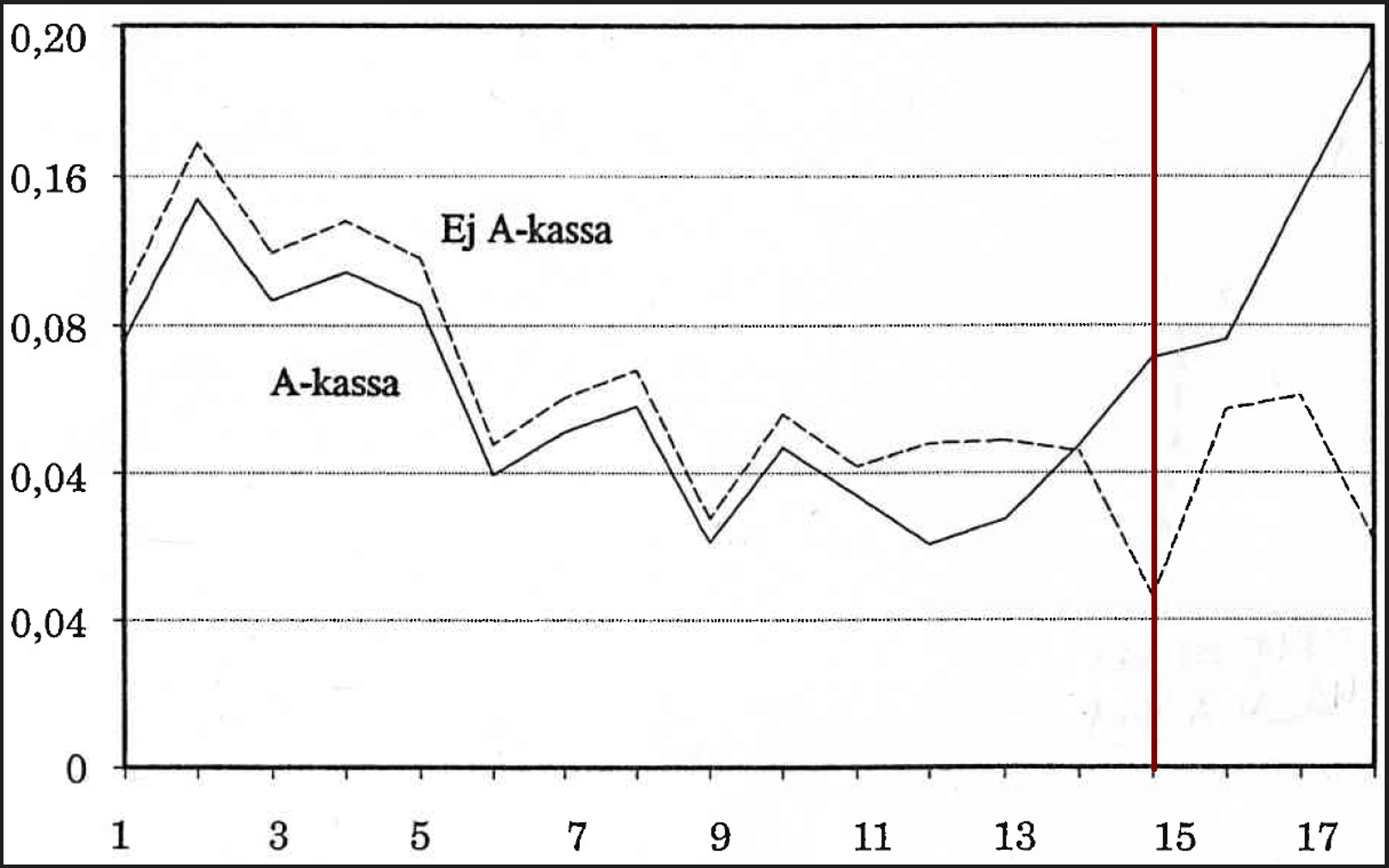
How should you interpret this figure? You can see that about 8% find a job in the first week. In the following weeks progressively fewer people find work. But after 14 weeks the pattern changes in a striking way: the solid line suddenly turns sharply upward. One group begins to get jobs! The odd thing is that this happens exactly when that group’s benefits end. The same clear change is not visible for the group that never received benefits — so the phenomenon cannot plausibly be explained by some other event that week that made it easier to get a job.
A third example of moral hazard can be glimpsed in an interesting study of what happens in emergency care when private firms are allowed to provide ambulance services. The researchers examine data on one million ambulance transports in Stockholm for 2009–2016. They find that private ambulances do respond faster to calls, but that patients are more likely to die than when ambulance care is provided by public operators. One possible explanation is that the private ambulance firms employed more hourly staff, younger personnel and had higher staff turnover.
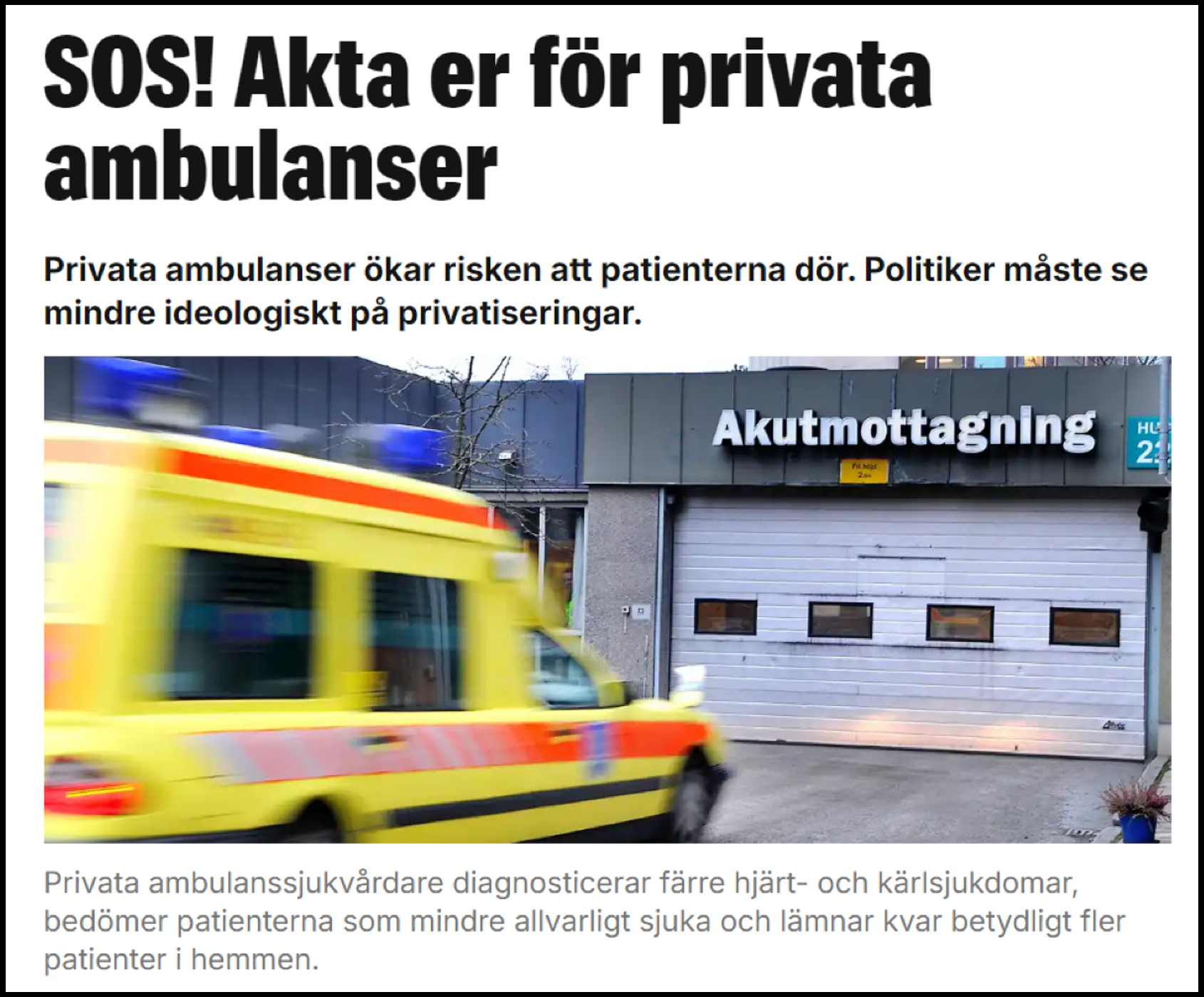
All these studies point to moral hazard in welfare systems. If you want to work in practical policy and decision‑making it is therefore important to understand people’s incentives and realise they may change behaviour in response to a reform. In the corporate world, knowledge of moral hazard helps you design better contracts and incentive structures that reduce the risk of one party acting against the other’s interests.
Finally: how serious is the problem of asymmetric information? In some respects the problem is bigger than, say, externalities. With externalities a third party is affected by a transaction while the direct buyer and seller themselves do not suffer. With asymmetric information it is the involved parties themselves who are harmed. On the other hand, asymmetric information is less severe than externalities because market participants face strong incentives to fix the problem themselves and to find clever solutions that allow cooperation to work.
Exercises
In this chapter you learned why markets fail when the seller knows more than the buyer or vice versa. Below are some cases where you can apply your knowledge in practice. Press Show Answers when you want the computer to grade your responses. Good luck!
Risks and insurance: Should Molly insure her smartphone?
The business idea of insurance companies is to help people avoid risks in exchange for a premium, but adverse selection and moral hazard cause problems.

- Which of the alternatives below would you choose?
A. You receive €5,000 for sure.
B. We flip a coin: if heads you get €10,000, if tails you get €0. - Do you think men are more or less likely to choose option A compared with women — in other words, do you think attitudes to risk differ by gender?
- In economics and everyday life it is useful to compute the expected value. If the probability is 50% that you receive €10,000 and 50% that you receive €0, the expected value is €5,000. You can think of the expected value as what you would get “on average” if this situation repeated many times. You compute the expected value by taking the probability of one outcome times the payoff in that case plus the probability of the other outcome times the payoff in that case: \(\small 0.5*10{,}000+0.5*0=5{,}000\). If the probability of getting €10,000 is 60% and the probability of getting €0 is 40% then the expected value is therefore .
- Molly has just bought a new smartphone. She smashed the screen of her old one, and she knows it very well may happen again. Molly estimates the probability of dropping her new phone at 10%, in which case she would have to buy a new phone for €500. What are Molly’s expected expenditures on phones?
- You are manager at the insurer If. You contact Molly with the following offer: “Do you want to buy the student insurance Drulle for €50? Then you will get a new phone if your old one breaks!” Molly is risk‑averse, i.e. she chose option A above. Will she accept your offer? .
Molly’s risk aversion is so strong that If can raise the premium to €60 and she still prefers to pay €60 rather than risk having to pay €500 if she drops the phone. This is how If makes big money (they get €60 from each customer while on average they only have to replace phones costing €50 per customer), and Molly avoids the stress of living with uncertainty.
- Adverse selection nevertheless creates problems for If. Explain!
- Give three concrete suggestions for what If can do to avoid the problem of adverse selection.
- Moral hazard also creates problems for If. Explain!
- Give three concrete suggestions for what If can do to mitigate the problem of moral hazard.
- There is no right or wrong answer. Both alternatives have the same expected value. In A you receive €5,000 for sure, whereas B requires you to gamble: a 50% chance to win €10,000 and a 50% chance to walk away with nothing. If you chose A you are risk‑averse — you prefer certainty to uncertainty. If you chose B you are risk‑seeking, and if A and B are equally attractive you are risk‑neutral.
- Many studies show that women on average tend to be more risk‑averse than men. This can lead them to make more cautious investments, which reduces the chance of large losses but also reduces the opportunities for large gains. Risk attitude can also help explain why some individuals start businesses more often, change jobs, gamble, or break social norms.
- If there is a 10% probability she must pay €500 and a 90% probability she does not, then her expected expense is €50 (0.1500 + 0.90).
- Being able to compute expected value lets you predict future outcomes based on probabilities. As an economist or social scientist this helps you make informed decisions in professional life. This tool is especially useful in risk assessment.
- Because Molly is risk‑averse she will accept the offer. Her expected expense is the same with or without insurance (€50), but with insurance she avoids the risk of having to pay €500.
- Write down a good answer on paper now — about three sentences. Then read it aloud. Can people understand what you mean? Keep it simple. Avoid waffle.
- See Table 9.1, but try to come up with your own and even smarter examples.
- Write down a good answer on paper now — about three sentences. Then read it aloud. Can people understand what you mean? Keep it simple. Avoid waffle.
- See Table 9.2, but try to come up with your own and even smarter examples.
Education as a signal
In Figure 4.1 we saw that Finns with a university degree earn substantially more than other groups in society. There are many possible explanations (think The Road Not Taken), but research shows that education does lead to higher wages. But why? Watch the following clip:
- Why, according to signalling theory, does education lead to higher wages?
- Give three concrete examples of factors that support the signalling theory.
- Due to an administrative failure, 10 of your classmates pass a course even though they lack the required knowledge. How does this affect the value of your degree under the signalling model? Explain clearly.
- Suppose you take a 20‑question multiple‑choice test. Passing requires 5 points. Each question has four options, only one is correct. A correct answer gives +1 point, a wrong answer gives −1/3 point. How many points do you expect to get if you take the test blindfolded? .
- The instructor now changes the test so each question has only three options and there are no penalties for wrong answers. How many points do you expect to get if you take the test blindfolded? .
- Watch the film.
- Watch the film.
- Here you must understand that a credible degree, according to signalling theory, allows employers to distinguish “high‑productivity” from “low‑productivity” applicants. Note the word credible. Think of the used‑car market. Only sellers of good cars would dare offer the guarantee “If any problem occurs I will pay all workshop costs for the next 3 years.” A seller of a bad car would be ruined by such a guarantee, so no one selling a lemon offers it. The guarantee is thus credible: buyers understand that any car sold with the guarantee must be good. Your university degree works exactly the same way: the employer must be 100% sure that everyone with an ÅA degree is “good.” The administrative failure in the exercise made it possible to obtain an ÅA degree without being good. That destroys the degree’s credibility. Employers can no longer be sure that an ÅA graduate is high‑productivity, so you can no longer use the degree to get the best jobs and the highest wages.
- Remember that expected value is computed as probability of outcome 1 × payoff 1 plus probability of outcome 2 × payoff 2. If you guess randomly on a 4‑option question, the probability of a correct answer is 25% (= +1 point) and of an incorrect answer 75% (= −1/3 point). The expected value per question is therefore 0.25×1 + 0.75×(−1/3) = 0. So the expected score on the test is 0 points.
- If each question has 3 options and wrong answers carry no penalty, guessing gives a 1/3 chance of correct (= +1) and 2/3 chance of incorrect (= 0). The expected value per question is 1/3×1 + 2/3×0 = 0.333…. With 20 questions the expected score from blind guessing is about 6.7/20. Do you see how this relates to signalling theory? Are penalty points for wrong answers kind or unkind?
Executive contracts: Why does the CEO get a monster salary?
The theory of moral hazard shows that managers can use bonuses and profit‑sharing schemes to incentivise employees to work hard for the firm’s benefit. Such pay systems are needed only in jobs where owners and boards have difficulty observing what employees actually do at work. Some researchers argue that rising income inequality partly stems from the fact that it has become harder to monitor on‑the‑job performance as more occupations become complex and can be done from home. The world map below shows the share of national income that accrues to the top 1% in each country.
- The share of income in 2022 that went to the richest 1% in Finland was .
- The country where the largest share of income in 2022 went to the richest 1% was .
- In which country in the world in 2022 did the richest 1% receive the smallest share of total income? .
- Explain how moral hazard among employees affects a firm’s profit.
- Give three concrete examples of how a firm can combat moral hazard among its staff.
- Play and explore.
- Play and explore.
- Play and explore.
- Read the text and reflect.
- See Table 9.2, but try to come up with your own — and even smarter — examples.
Moral hazard and welfare systems
Moral hazard can also arise in our public welfare insurance systems (such as health insurance and unemployment insurance) in the same way it can arise among customers of private insurers.
- Can you give three practical examples of measures Finnish authorities have implemented to reduce the incidence of moral hazard in the welfare systems?
- Do you think the student‑support system gives rise to moral hazard — and if so, can you give three concrete suggestions for how authorities could design student support to reduce the incidence of moral hazard?
- Waiting periods and eligibility controls: many benefits require medical certificates or have an initial unpaid waiting period (e.g. for sick pay or unemployment benefits), which reduces opportunistic claims and discourages short‑term misuse. Active‑labour requirements and conditionality: receipt of unemployment benefits is tied to obligations to search for work, attend activation measures or accept reasonable job offers; failure to comply can reduce or suspend payments, aligning recipients’ incentives with return to work. Cost‑sharing and deductibles in insurance schemes: introducing co‑payments, deductibles or forfeitable benefits (e.g. a deductible on certain healthcare items, or lower benefit levels during an initial period) makes beneficiaries bear part of the cost and thus reduces moral‑hazard behaviour (overuse, unnecessary claims).
- Read the text and reflect.
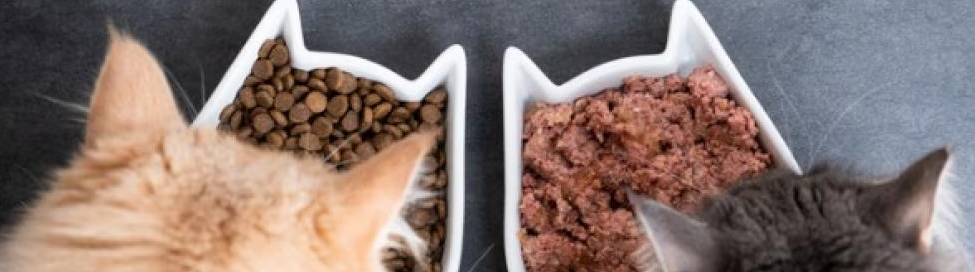
We tie up the micro package: Why is cat food so expensive?
You have now completed the whole of microeconomics. To demonstrate that you can really “do a somersault” on the exam, you will now analyse the market for PuckoCat — a cat food sold at Citymarket in Turku. This case tests your knowledge from chapters 1 to 10.
- In theory, most cat owners in Turku could catch herring in the Baltic Sea or hunt rats themselves to make homemade cat food. Using the concepts of opportunity cost and comparative advantage, explain why almost everyone still chooses to buy ready-made cat food at Citymarket.
- Assume the market demand for PuckoCat per week is given by \(\small Q_D=1,200 − 100P\) and the supply by \(\small Q_S = −300 + 200P\), where Q is the number of cans of PuckoCat and P is the price in euros. Assume perfect competition. In equilibrium the market price P is per can, and cans are traded per week.
- At this equilibrium the consumer surplus (CS) is euros and the producer surplus (PS) is euros.
- A single producer of PuckoCat acts under perfect competition and sells its cans at the market price P = 5 euros. The producer’s total costs per week are given by \(\small TC(q) = 200 + 2q + 0.01q^2\), where q is the number of cans the producer manufactures. The firm’s fixed costs (FC) are euros per week. Differentiating TC(q) with respect to q gives marginal cost \(\small MC(q) = 2 + 0.02q\). To maximise profit the firm should produce cans per week. At this optimal output the firm’s total revenue is euros, total costs are euros, yielding a profit of euros per week.
- If the producer of PuckoCat is granted a patent on its recipe, the firm becomes a monopoly. Explain why this monopoly leads to a higher price and a socially inefficiently small output (deadweight loss).
- Suppose the monopolist engages in price discrimination. Which group of consumers will pay the highest price for the cat food? Answer: .
- Citymarket’s shelves currently hold over 40 different varieties of cat food. Explain why this occurs and what effect this market structure (monopolistic competition) has on price and firm profits in the long run.
- Assume demand for cat food is very inelastic (because cats refuse to eat anything else) while supply is elastic. If the government imposes a tax on cat food, who will bear the largest share of the tax burden in practice? Answer: .
- The production of cat food requires large quantities of fish. This contributes to the overfishing of herring in the Baltic Sea. Explain why the free market fails to protect fish stocks (hint: the tragedy of the commons), and how an environmental tax (a Pigouvian tax) can help steer production toward the socially optimal level.
- A cat owner cannot possibly know whether a tin actually contains premium salmon or just cheap fish trimmings before opening it. Explain how this asymmetric information can lead to adverse selection — where good-quality cat food is driven out by junk — and how producers of high-quality cat food can use signalling to rescue the market.
- Opportunity cost and comparative advantage: Think of Thomas Thwaites’ toaster. It illustrates how incredibly inefficient it is to try to do everything yourself. Catching herring or hunting rats on your own takes a huge amount of time, and your time is limited. Your opportunity cost of that time is the value of the next best thing you could have done (e.g. studying for your exam or doing extra shifts at Prisma). By buying ready-made cat food you exploit the cat-food firm’s comparative advantage through specialisation.
- Remember that equilibrium is about balance on the scales. Set quantity demanded equal to quantity supplied (\(\small Q_D = Q_S\)) and solve for the price P that makes buyers’ willingness to pay match sellers’ willingness to sell. Then substitute that price into either the demand or supply function to get the equilibrium quantity Q. If the price were lower than the equilibrium price, sellers would not supply enough, creating a shortage (excess demand) that pushes the price up.
- Consumer and producer surplus: CS and PS show what buyers and sellers gain from a functioning market. CS is the area under the demand curve but above the equilibrium price (the difference between your maximum willingness to pay and what you actually paid). PS is the area above the supply curve but below the equilibrium price (the difference between the lowest price the seller would accept and what they actually received). Remember the formula for the area of a triangle: (base × height) / 2.
- Firm choice, marginal analysis and differentiation: Fixed costs (FC) are costs the firm must pay even if production is shut down (i.e. q = 0). Profit maximisation is about thinking on the margin. As long as the revenue from one more unit sold (MR, which under perfect competition equals the market price P) exceeds the cost of producing it (MC), profit increases if the firm produces more. Set MR = MC and solve for the firm’s optimal output q. Profit is then the difference between total revenue (TR = P × q) and total cost (TC).
- Monopoly and deadweight loss: A monopolist faces the whole market demand and can choose the price. But to sell an additional unit the monopolist must lower the price on all previously sold units. Therefore marginal revenue (MR) falls faster than the price. By producing where MR = MC, the monopolist deliberately restricts quantity and charges a higher price, creating an inefficiency (deadweight loss) for society because mutually beneficial trades do not occur.
- Price discrimination: The monopolist wants to extract as much surplus as possible by segmenting customers according to their price sensitivity (price elasticity). The group that is least sensitive to price (most inelastic demand — for example, desperate show-cat owners who refuse to feed anything but premium food) will pay the highest price.
- Monopolistic competition: The 40 varieties on the shelf are the result of product differentiation under monopolistic competition. Firms niche themselves to obtain a temporary monopoly and earn profits in the short run. But in the long run these profits attract new entrants (like flies to a sugar cube), which reduces demand per firm until economic profit is driven to zero.
- Tax incidence: Who bears the larger share of the tax burden depends entirely on price elasticity. The side that is least responsive to price changes (least elastic — i.e. the cat owners whose cats refuse to eat anything else) will bear the larger share because they continue to purchase despite the price increase.
- Tragedy of the commons and environmental tax: The herring in the Baltic Sea is a common resource (non-excludable but rival in consumption). Because no one owns the fish in the sea, individual fishers have no incentive to conserve for tomorrow, which leads to overexploitation (“the tragedy of the commons”). An environmental tax (a Pigouvian tax) forces producers to internalise these hidden costs by making them feel it in their own wallets.
- Asymmetric information, adverse selection and signalling: This is the used-car market in disguise. Because the buyer cannot verify quality beforehand (asymmetric information), they are only willing to pay an “average price”. That price is too low for producers of high-quality food, who then exit the market (adverse selection). To save the market, high-quality providers must send a credible signal (e.g. independent certifications or guarantees) that low-quality producers cannot afford to mimic.
- Do schools use “high grades for all students regardless of performance!” as a way to attract many students and thereby make large profits at taxpayers’ expense? This example of moral hazard is currently receiving a lot of attention in Sweden. Handelshögskolan has had enough of grade inflation.
- Uusitalo & Verho (2010) is a Finnish study in which the researchers found that an increase in unemployment compensation in 2003 — from 52 to 60 percent of previous wages — resulted in the average duration of unemployment increasing by 30 days. By the way, do you remember Pontus in Chapter 1? He analysed this exact question in his bachelor’s thesis and reached similar conclusions.
- You can read more about the interesting study on private ambulances here.
- An interesting example of moral hazard can be seen among real estate agents. Levitt & Syverson (2008) analyses large amounts of house-sale data and finds that agents work much harder, and do a better job, when selling their own houses than when selling houses for clients. Incentives matter! The video below explains it in about 1 minute: